Archive for the ‘Cool Stuff’ Category

Of Space Phlebotomy and Chipped Teeth

Tuesday, April 11th, 2006

Here’s something I hadn’t thought about. (And I’m willing to bet few people have.) Ever consider how many things us earthbound folks take for granted, but would require some additional thought in space?

Sure. Astronauts have to eat and sleep in space, along with all the other things they normally do on earth, but without the benefit of gravity.  According to New Scientist Space, simple procedures like getting blood samples are a little more complicated when human health emergencies arise in space. 
Space Needle

Taking blood from arteries can be crucial in diagnosing problems in health emergencies – but doing so in the microgravity of space is tricky and potentially dangerous.

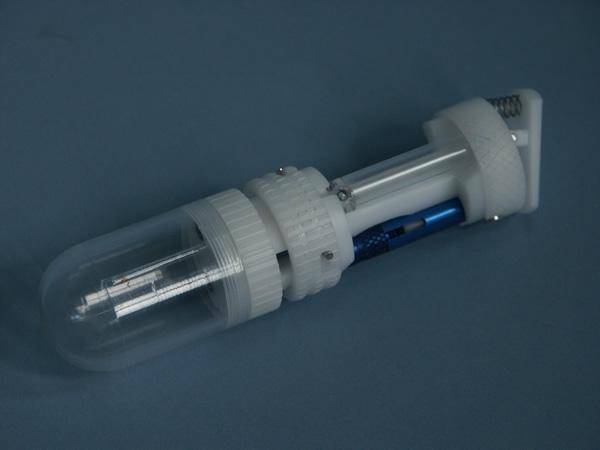
Now researchers have come up with a potential solution – a thumb-sized gadget that collects a sample from the earlobe.

Blood is easiest to collect from veins, but this blood is on its way back to the heart and has been de-oxygenated and altered in the body’s tissues. This means it is not as useful for monitoring serious health problems as blood coming fresh from the heart in arteries.

"But the technique to collect blood from the artery is complicated and needs a lot of training," says Thais Russomano, at the Microgravity Laboratory of PUCRS University in Brazil. "It can also be painful and blood clots or infection can result. So it can be a bit dangerous to perform that in space."

So Russomano and her colleagues created the device to collect samples of "arterialised blood" from the earlobe. This serves as an accurate substitute for arterial blood. The system clips onto a subject’s earlobe and contains both a small cutting blade and a collection chamber, to ensure no blood can spill and contaminate the spacecraft. The device is operated with a twist and is said to be virtually painless.

Kinda gives the term "space needle" a whole new meaning doesn’t it? 

Maybe you should take it with a grain of salt, as New Scientist Space also reports that they were duped some art students who claimed to have invented a "cell phone tooth" by implanting a vibrating radio receiver in a human tooth.  So were a a few others, including Time magazine and Wired, the latter of which just exposed the fraud

Then again, maybe no one should be embarrassed by this. After all one person’s idea of a joke is often turns into someone else’s idea of "crazy enough to work." Scoble recently posted about a guy who implanted an RFID chip into his hand and posted a video about it.  (It’s been done before, of course.) And if you believe The Register, Belgian scientists have embedded RFID chips into — wait for it — human teeth. 

So, hoax or no, the "cellphone tooth" isn’t all that far fetched. And if it comes to pass, those who were duped before can claim "we always new it was possible" and claim the cutting edge.

Mars, In Color

Monday, April 10th, 2006

Friday saw the release of the first color image from NASA’s Mars Reconnaissance Orbiter.

ABC News reports:

The crisp test images released Friday revealed pocked craters, carved gullies and wind-formed dunes in Mars’ southern hemisphere. The diverse geologic features show the importance of water, wind and meteor impacts in shaping the Martian surface, scientists said.


The orbiter, the most advanced spacecraft ever sent to another planet, reached Mars on March 10 and slipped into an elliptical orbit. Over the next six months, it will dip into the upper atmosphere to shrink its orbit, lowering itself to 158 miles above the surface.

Last month, the orbiter beamed back the first view of Mars from an altitude of 1,547 miles. Those first test images were meant to calibrate the high-resolution camera aboard the spacecraft. The latest images were taken at the same time, but scientists spent several weeks processing them.

The Reconnaissance Orbiter will begin collecting data in November, and scientists expect the resolution of those images to be nine times higher.

The image is in infrared color– so the colors seen in this post are not what would be seen by the human eye.

 For additional information on the above image, click here.


NASA Goes to China?

Thursday, April 6th, 2006

The China story is getting more interesting. I only found out a couple of days ago that China has a space program, and some pretty ambitious plans to go along with it. At the time I wasn’t sure how serious the news was as far as the U.S. space program is concerned. Now I find out, via The Write Stuff again, that apparently it’s serious enough that NASA may send someone to China to check things out.

Chinese space officials have invited NASA Administrator Michael Griffin to visit their country in the fall, possibly as early as September.   

During an informal visit to NASA headquarters in Washington, April 3, Luo Ge, vice administrator of the China National Space Administration, met with Michael F. O’Brien, NASA associate administrator for external relations, to discuss a potential trip by Griffin to meet with Chinese space officials and visit their facilities, possibly as early as September.

“I made a joke with Mr. O’Brien that if we need to get married some day, we have to meet; otherwise we cannot get married,” Luo said in an interview here following his morning keynote speech April 5 at the 22nd National Space Symposium. Luo described the visit with O’Brien as “only a drop in” with two purposes:” to see an old friend” and to discuss Griffin visiting China.

Marriage proposals aside, that’s rather interesting news. Granted, it’s only an invitation, I haven’t heard whether it’s been accepted. But Lou did speak earlier about China’s willingness for space collaboration, and given Tom DeLay’s rather dire warning about the "space race" with China, it might be smart for NASA to at least give the Chinese program the once over; especially considering who else could be entering the "space race." 

If Matt Tompkins over at DefenseTech.Org is right when he says "Don’t Freak" over reports that China is set to overtake the U.S. in technology development, NASA may find it has nothing to worry about.  And with China concerns about its U.S. debt holdings, and  news that Iran is entering the space race too, some kind of U.S. – China partnership could be advantageous for both.

Mind you, I’m just a newbie who’s trying to sort all this stuff out. And I wouldn’t’ mind a little help.

Space Symposium Kicks Off in Colorado

Wednesday, April 5th, 2006

The 22nd National Space Symposium opened its doors in Colorado Springs, Colorado yesterday.

The Symposium, sponsored by the Space Foundation, is an annual space industry conference that brings members of the global space industry and the military together.

Space.com reports:

“In terms of intellectual content, this Symposium is clearly our most exploration-focused and most commercial-entrepreneurial focused ever, said Elliot Pulham, President and Chief Executive Officer of The Space Foundation… 

Local station KKTV looks at what’s of interest to the general public:

This year’s show features a robot who can dance and entertain named "Sprockit." It also features NASA’s Crew Exploration Vehicle, or C.E.V. NASA says the C.E.V. will replace the shuttle and sit four to six people.

The C.E.V. is a refined version of the old Apollo vehicle. They say it’s safer than a shuttle and more economical. 

 More stories can be found here. You can also check out photos from the symposium and even check out the live webcam of the exhibit hall (in the left hand column).

 Organizers expect more than 7,500 people to attend the symposium, which runs through tomorrow at the Broadmoor Hotel.


China’s Sputnik?

Tuesday, April 4th, 2006

It’s gonna get crowded up there. In space, I mean. On the moon in particular. And the key to it all may be soon-to-be-former Congressman Tom DeLay. I thought it was down to the U.S. and Sweden in the latest lap of the "space race."  But it looks like there’s one more player entering the arena. I checked my RSS reader this afternoon, and found out via NASA Watch that China has plans for space exploration to the moon and beyond.

A top Chinese space official on Monday described China’s ambitious exploration plans, including robotic Moon missions starting next year.

Beyond Moon missions, including a flight to collect and return lunar samples to Earth in 2017, the Chinese space agency plans to develop a nonpolluting launch vehicle that can lift 55,000 pounds (25,000 kg) into orbit by 2010, said Luo Ge, a vice administrator at the Chinese National Space Administration.

"Space is a high-risk investment," Luo said through a translator at the Center for Strategic and International Studies, a Washington think tank. "China as a developing country is limited and constrained by its funding for more ambitious programs."

But Luo says China has an edge because of the progress of its space program, the country’s "openness" — citing its work with countries like Russia, Nigeria, and Brazil — and because the U.S. has grown more closed since the 1990s. The Write Stuff, space blog of the Orlando Sentinel’, points to a story that repeats Luo’s claims and notes the successes of China’s space program, including a manned spaceflight last October. 

But is there anything to China’s claims? And How does Tom DeLay figure into all of this? 

Jeff of Space Politics reminds us that none other than Tom Delay warned just a week ago that the U.S. is in a "space race" with China, and even called China’s space program "a 21st century Sputnik moment"

I’m not sure I buy that comparison, as it sounds like a bit of hyperbole to me. After all, Luo even noted that China’s $500 space budget is barely bus fare compared to NASA’s $16.6 billion. But then again NASA is losing a powerful backer in Tom Delay, and having to pinch pennies for the moon mission even as scientists are clamoring for more

Plus Jeff also speculates that, since he called for a special oversight hearing on NASA’s human space space program during a congressional hearing last week, the Chinese space program might be one reason for DeLay’s 2-month "delay" in actually leaving office. Maybe ensuring NASA stays well head of China’s"sputnik" will be DeLay’s swan song.

I suppose Jeff could be right. After all, just last week I thought Sweden was America’s biggest competitor in space. They don’t call me NooBee (i.e. "newbie) for nothin’, folks.

iPod From Space Falls to Earth

Tuesday, March 28th, 2006

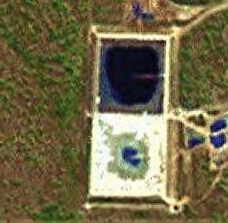
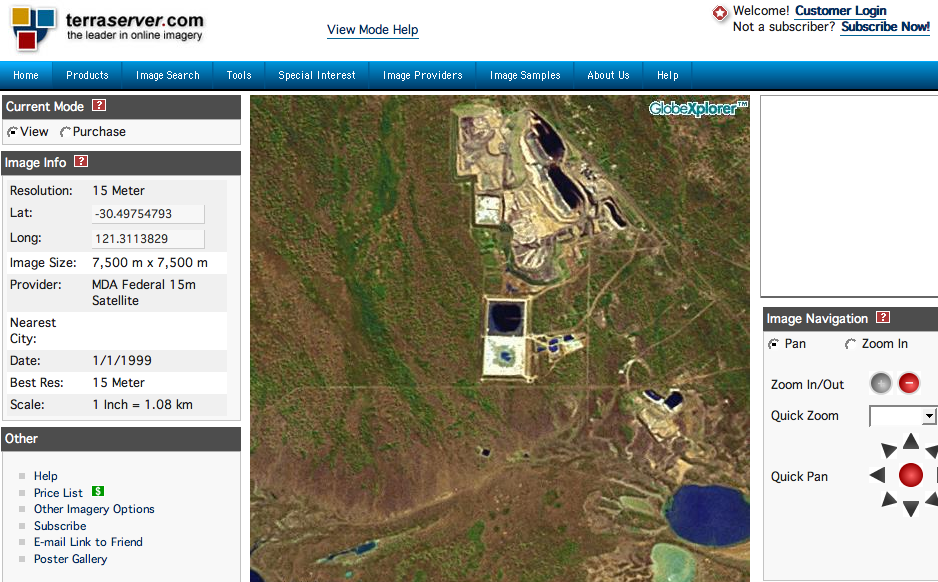
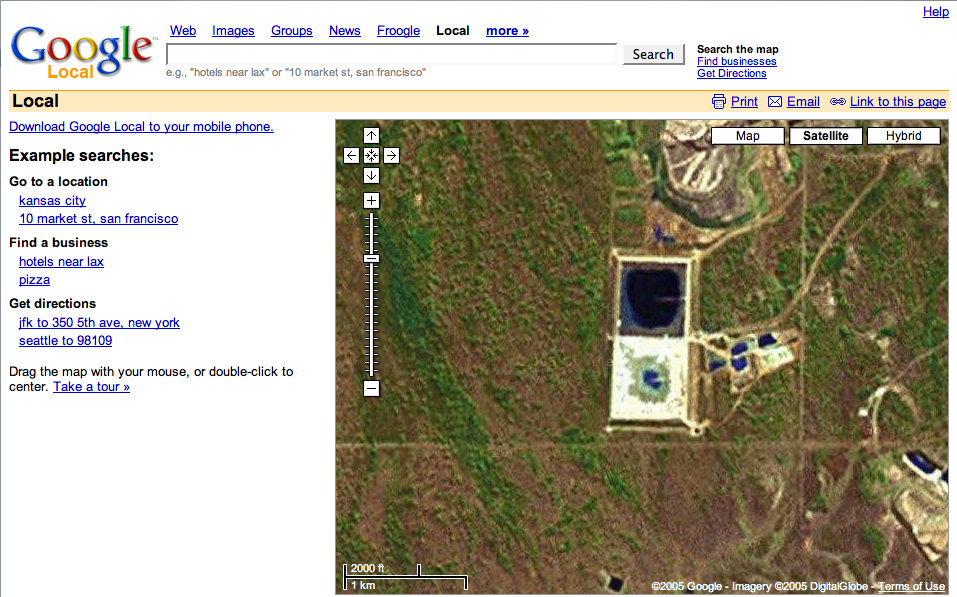
It was fun while it lasted, huh? We saw the Gizmodo post yesterday, about the iPod advertisement that’s viewable from space, and filed it away for future reference. Turns out that, after rocketing around the blogosphere, it’s probably not what it looks like. Some intrepid bloggers noted that the Terrabyte satellite image for that location on January 1, 1999 — before the iPod launched — looks the same  as it does Google Earth today.

We’ve got both images. Care to guess which is which?


It gets better. The Terabyte server’s been rather busy, so when we got a chance we grabbed a screenshot of the whole page. (Note the date.)


terrabyte1999

And we grabbed a shot of Google Earth as well. 


googleearth

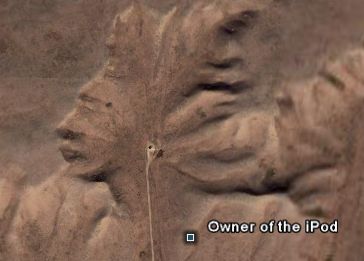
And fun would it bit of snark? The author of the the original post suggests he knows the identity of the legendary space-iPod’s owner.

It is just me? Do things not always look like what they are when seen from space? Or is am I seeing ancient Egyptian royalty here? 

So, is there anything else that looks like an iPod from space? How many can you find?

Making MobTV Work

Friday, March 24th, 2006

I’ve decided to try my hand at coining a new phrase: mobTV. I figure if mobile blogging can become "moblogging", then mobile television can become "mobTV." Besides, as I’m learning more about it and writing more about it I’m going to need a more efficient way to refer to it if I want to keep up, given the way its spreading and the number of terms I have to learn. 

Since my last post on the mobTV taking off in Korea, it looks like mobTV is coming to China next, if Radioscope has its way.  And on a pretty cool looking phone, if you ask me.

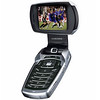
Samsung MobTV PhoneRadioscape has won contracts to supply five more Digital Multimedia Broadcast (DMB) and Enhanced Packet Mode (EPM) transmission systems for mobile TV operators in China, bringing the total to nine in the past few months.

 The company says the contracts are the fruits of at least two years of courting Chinese authorities about its DAB-based mobile TV technology and helping them evaluate the most appropriate technologies for the service, and choosing between DMB, DVB-H and DMB-T.

From there it gets interesting. Qualcomm announced last year that it was bringing mobTV to the states via a  technology called MediaFLO, which Verzion also adopted late last year. For the curious, Mobile Content News has video of MediaFLO in action. (Found via Engadget, and I believe that’s Shrek on the small screen.)  The question is, can it work? The experts aren’t  exactly in agreement. Depending on who you ask, MediaFLO and another technology called DVB-H are doomed because EV-DO already gets the job done and new networks are too expensive to build and support, or DVB-H will be the de facto standard once spectrum allocation problems are solved.

Got all that? Good, because I’m about to add some French to the mix. Alcatel just announced that it’s overcome the spectrum allocation issue by using a satellite frequency.

With the help of satellites, Alcatel aims to overcome a key hurdle in rolling out broadcast television services over mobile phones: the lack of available spectrum. 

The French telecommunications-equipment manufacturer proposes using the widely available S-Band frequency reserved for satellites to transmit broadcast signals both terrestrially and via satellite to mobile phones based on the DVB-H (digital video broadcasting – handheld) standard, instead of the UHF band. 

… The Alcatel proposal calls for equipping base stations with S-Band repeaters and, in addition, using satellites capable of transmitting in the S-Band to deliver content to 3G (third-generation) phones enabled with DVB-H technology in three different ways: base-station streaming, base-station broadcasting and satellite broadcasting.

The article also does a good job of explaining the drawbacks of the three delivery systems. Streaming offers unlimited channels and great indoor coverage, but only for a limited number of users on a network. Broadcast matches it on indoor coverage, and supports unlimited users, but only 27 channels. Satellite matches them on channels and user support, but falls short on indoor coverage. Alcatel claims the answer is an "intelligent content-management system" that seamlessly chooses the right delivery system. 

Leave it to the French to come up with an elegant solution. I just hope it works well enough to eventually get picked up in the U.S. It would be great to catch up on Desperate Housewives reruns on the subway, and get all the way up the street to my office without losing the signal.

Hunting for Stars, Through the Light

Wednesday, March 22nd, 2006

This is a great effort:

Join thousands of other students, families, and educators by participating in GLOBE at Night – an international event designed to observe and record the visible stars as a means of measuring light pollution in a given location. Participation is open to anyone – anywhere in the world – who can get outside and look skyward during the week of March 22-29, 2006! There is no cost to participate in GLOBE at Night. Help us reach our goal of 5000 observations from around the world!

 The National Optical Astronomy Observatory, which is sponsoring the event, also has a cool online tool that allows you to witness the changes in the night sky that result from light pollution.

For more information, download the GLOBE Family Activity Packet PDF (in English and Spanish) or subscribe to the GLOBE email list. 

Robots on the Road

Monday, March 20th, 2006

Here’s another post about people building the darndest things. On March 28th, thanks to the folks at Darpanet, you’ll be able to watch a dozen driverless vehicles — created by people ranging from entreprenuers to students and hobbyists — attempt to successfully navigate 130 miles of Mojave desert terrain on NOVA’s The Great Robot Race. NOVA’s companion site features background on the dozen teams competing for the $2 million prize, as well as videos of their vehicles, and a preview of the upcoming show. 

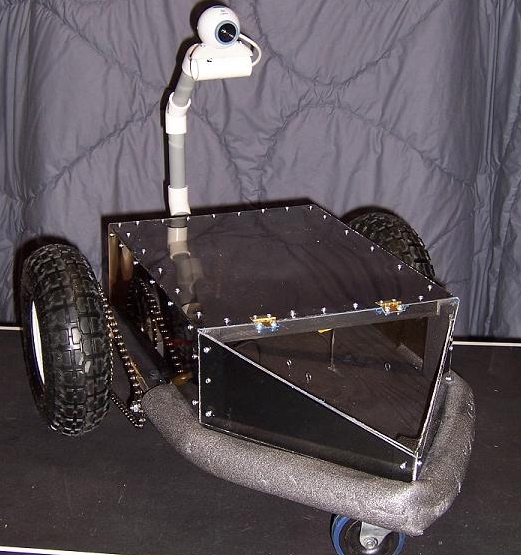
Sounds impressive, and you can bet that with $2 million at stake a lot of time and resources went into building these prototypes. However, my favorite robot vehicle of the day won’t qualify for the competition. It’s a wi-fi rover I found via Make  magazine, built at a cost of $103 by a high school student who won second place in a local science fair with his creation.


He’s got plans to add GPS, and other neat gadgets. After building a robot on just over $100, I wonder what this kid could do with even a fraction of the Great Robot Race prize money.

The (Private) Race for Space

Monday, March 20th, 2006

We’ve written before about the incipient space tourism industry; yesterday the AP released a story that summarizes the gathering momentum of what was, not too long ago, a "sleepy industry":

Two years after the first privately financed space flight jump-started a sleepy industry, more than a dozen companies are developing rocket planes to ferry ordinary rich people out of the atmosphere.

Several private companies will begin building their prototype vehicles this summer with plans to test fly them as early as next year. If all goes well, the first tourist could hitch a galactic joy ride late next year or 2008 – pending approval by federal regulators….

"This time, it’s personal. This space race is about getting ‘us’ into space," said space historian Andrew Chaikin.

For now, commercial space travel remains an exclusive club.

Over the past few years, three tourists have paid a reported $20 million each to ride aboard a Russian rocket to the orbiting international space station.

Instead of days in space, the commercial spaceships under development will only reach suborbital space, a region about 60 miles up that is generally considered the beginning of the rest of the universe. Since the private spaceships lack the speed to go into orbit around Earth, the flights are essentially up and down experiences – lasting about two hours with up to five minutes of weightlessness.

The article includes a summary of the major contenders in the space-tourism arena:

The biggest name is Virgin Galactic, a space tourism firm founded by British billionaire tycoon Richard Branson. Branson has partnered with Burt Rutan, whose SpaceShipOne in 2004 became the first private manned craft to reach space, to build a fleet of suborbital commercial spaceships called SpaceShipTwo….

_Oklahoma-based Rocketplane Kistler is one of Virgin Galactic’s biggest competitors. Rocketplane Kistler, whose main investor is American businessman George French, hopes to start test flights next January and fly commercially by next summer. French owns several businesses including a space education company in Wisconsin….

_Space Adventures, a Virginia-based space travel agency best known for brokering three tourists to the international space station, is the latest entrant.

Last month, Space Adventures announced a partnership with members of the Ansari family – the major funders of the $10 million X Prize won by SpaceShipOne – to develop Russian-designed suborbital rockets that would launch from a proposed spaceport in the United Arab Emirates by 2008.

You can check out Rocketplane here and Virgin Galactic here.