Archive for the ‘Cool Stuff’ Category

The Big Break-Up

Friday, April 28th, 2006

Everybody’s talking about the big break-up. No, I don’t mean Nick and Jessica. I’m talking about Schwassmann-Wachmann, a comet that supposed to swung by earth next month, after it — according to one report — broke up for no apparent reason ten years ago. 

In 1995, Comet 73P/Schwassmann-Wachmann 3 did something unexpected: it fell apart. For no apparent reason, the comet’s nucleus split into at least three "mini-comets" flying single file through space. Astronomers watched with interest, but the view was blurry even through large telescopes. "73P" was a hundred and fifty million miles away.

No apparent reason? Not exactly. 

Naturally, I’m not the guy with the answers on this. (Again, I refer you to the screen name.) But Phil over at Bad Astronomy has what seems like a reasonable explanation to me. 

The exact cause is a mystery, though there are plenty of reason why a comet would fall apart. Comets are made of rock and ice. When they get near the Sun, the ice sublimates– turns directly into a gas — and flows into space, which is why comets look fuzzy in pictures. The actual nucleus, the solid part, is very small, but the coma, the fuzzy part, can be thousands of miles across.

It makes sense that after repeated passes of the Sun, enough ice is lost to venting that the structure of the comet can be fragile, since the ice in a way is holding the comet nucleus together. Once enough ice is gone, a breakup could occur if the sublimating ice builds up enough pressure to disrupt the structure. But that is just one explanation. The famous comet Shoemaker-Levy 9 broke apart because of the immense tidal forces of Jupiter’s gravity. Most comets don’t break apart; look at comet Halley, which has been circling the Sun for a long, long time (it was seen in ancient times). It goes to show that some comets are very fragile, and some are not.

OK, so it’s just one possible explanation, but it’s one more than I could come up with on my own. But just for the sake of argument, what other explanations could there be? Unless Bruce Willis or Morgan Freeman had an hand in it, I’ll take Phil’s explanation for now. (HubbleSite has the pics.)

NAB2006: TV Masters Illuminate Content Distribution

Thursday, April 27th, 2006

IMAS Publishing’s NAB Daily has a great set of stories covering events and presentations at the conference.

Though a good deal of the conference focuses on tech, in the end content remains king, and a new media platform will only succeed if there’s something interesting to watch on it. Distributing that content is opening up new revenue streams for companies both young and old, as conference attendees learned at yesterday’s Television Masters Luncheon:

The event was entitled, "New Distribution Pipelines: Turning TV Content Into Revenue."

The keynote address, delivered by Anne Sweeney, co-chair of Disney Media Networks and president of Disney-ABC Television Group, focused the necessity of change to maximize opportunity.

"Our industry is in the midst of a seismic shift," Sweeney said.

Citing an earlier era when cable and home video first threatened broadcasters, Sweeney cautioned the audience against "old thinking."

"Take heart, we have successfully overcome it in the past. We adjusted to the changing reality to reclaim our viewers," she said.

Sweeney said ABC made history when it agreed to make its content available on Apple’s iTunes service. Learning from the mistakes of the music industry, the network understood that this distribution route would not cannibalize its content’s value, but rather enhance it.

"iTunes created a new revenue stream for our content," Sweeney said.

Disney will continue to test and experiment in an effort to discern viewers’ preferences, Sweeney said. She described a planned ABC.com project during May and June in which episodes of popular ABC programs will be offered as free streams – including three required-viewing ad breaks.

"These emerging platforms aren’t ‘alternate,’ they’re additive," she said.

Sweeney acknowledged that the path from traditional broadcasting to today’s divergent distribution was a challenging one.

"We don’t have all of the answers, but we’re committed to working with our affiliates for the answers," she said. "I like the fact that old media is leading the way into the future."

In the lively panel discussion that followed Sweeney’s address, moderator Tony Kern of Deloitte & Touche led industry luminaries through the maze of issues facing both networks and affiliates.

Larry Kramer, president of CBS Digital Media, advocated experimenting with different ingredients, methods and technologies. "We’re basically trying everything," he said.

Kramer described CBS’ experiment with free streams of its 2006 March Madness broadcast. While the 2005 event, which required viewers to pay, drew an audience of 25,000, this year’s Webcast was served to five million viewers, 300,000 of whom signed on the first 15 minutes of the telecast.

Kramer felt the CBS broadcast audience hadn’t been compromised by the move. "Who wouldn’t rather be watching at home on a 50-inch plasma?" he asked. Instead, the Web feeds reached viewers who would otherwise have missed out on the network telecast, and the numbers bore out that hypothesis, revealing the highest ratings for that event in eight years.


ER on the Moon?

Friday, April 21st, 2006

Back to robots for just a minute. I mentioned the pregnant robot earlier, the one used to help train medical students without the need for human guinea pigs. I also blogged about the challenge of meeting medical needs in space. Well, those topics have come together in a pretty interesting way. With help of a NASA robot, emergency surgery in space may have just gotten a lot easier. 

Using a cramped undersea laboratory off Florida’s Atlantic coast, NASA astronauts and medical experts have teamed with an experimental robot to demonstrate long-distance surgical procedures that might one day save the life of a critically injured explorer on the moon or Mars.

The mission to evaluate a new branch of health care called telemedicine and the use of robots in surgery will draw to a close today when the three-man, one-woman crew leaves the research facility 62 feet below the water’s surface where they have lived since early this month.

During their stay aboard the 43-foot-long Aquarius, submerged among the coral reefs off Key Largo, Fla., physician Tim Broderick and three astronauts — Dave Williams, Ron Garan and Nicole Stott — assisted as Canadian surgical researchers 1,250 miles away sent commands to a robot inside the laboratory.

Responding to those commands, the portable robot sutured a badly damaged vein in the wounded arm of a patient simulator, a lifelike medical teaching aide constructed of rubber and fabrics that mimic human tissue and contain bloodlike fluid.

"Patient simulator"? "Lifelike medical teaching aide"? Is it me or does that sound like a robot doing surgery on a robot? I guess it’s better that way, as long as they’re experimenting, but I supsect they won’t get any notes about cold hands or bedside manner from a "lifelike medical teaching aide."  

Via Mars Blog.

More Space Junk

Thursday, April 20th, 2006

If you read NooBee’s post about SpaceNet 4’s retirement (below) yesterday, then you know that space– or at least the Earth’s orbit– is full of junk.

But now there’s something you can do about it. Sort of. At least, there’s a cool way you can spend some time (or a great deal of time, depending on how highly you rate the things you should be doing at work) learning about the wide range of space junk floating in the earth’s orbit: by playing this free online game

The junk is out there.

Pregnant, Swimming Robots

Tuesday, April 18th, 2006

Wanna buy a robot fish? How about a pregnant robot? I don’t think the first one’s for sale, but the last one is gonna cost ya about $20,000. These were two of the robot-related items that landed in my news reader this morning; the former casued me to ask "why would someone build this?", while the latter had me asking "why not?"

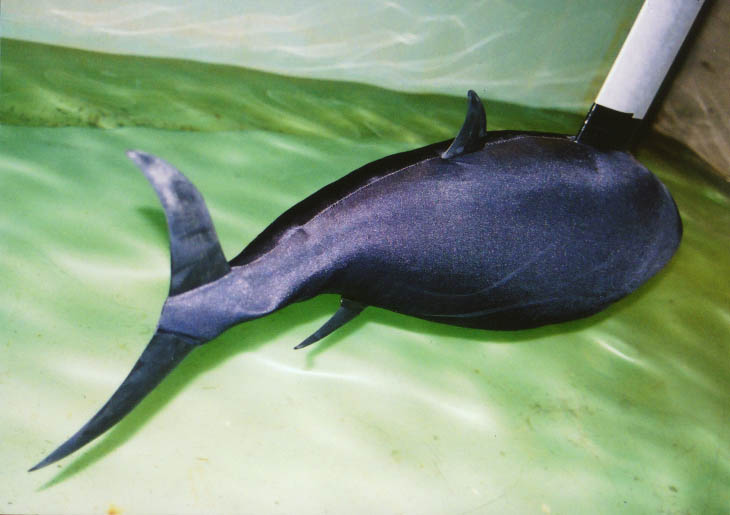
RoboTunaNotes from the Technology Underground clued me in to the existance of MITs’ RoboTuna, and pointed me to  Pink Tentacles’ post about a robotic carp recently turned loose in a Japanese aquarium.  While it seems like a pretty cool thing to invent, and maybe it will help scientst learn more about the "phsyics of swimming" as Bill puts it at Notes, I’m kinda left wondering what the point of the whole exercise is, other than invention for inventions sake. (Not that there’s anything wrong with that.) 

The pregnant robot, found via The Raw Feed (which also links to the robot’s instruction manual), is probably stranger the RoboTuna, but the reasons for building it are easier for me to grasp. 

NoelleThe full-sized, blond, pale mannequin is in demand because medicine is rapidly abandoning centuries-old training methods that use patients as guinea pigs, turning instead to high-tech simulations. It’s better to make a mistake on a $20,000 robot than a live patient.
… Noelle, from Miami-based Gaumard Scientific Co. Inc., is used in most of Kaiser’s 30 hospitals nationwide, and other hospitals are putting in orders. The Northwest Physicians Insurance Co. is sponsoring similar training programs in 22 hospitals in Oregon and Idaho, rolling out Noelle initially at five of them.

Other companies make lifelike mannequins to train paramedics in emergencies, but Noelle appears to be the only high-tech, pregnant model available.

Not a bad idea. A robot will probably not react to hearing an "Oops" during deliver in the same way an actual person would. I’ll say it again; people build the craziest things, and for reasons I don’t always get but that sometimes end up making sense.

COSMIC Launch

Monday, April 17th, 2006

COSMIC— the Constellation Observing System for Meteorology, Ionosphere and Climate– was successfully launched from Vandenberg Air Force Base in California on Friday night. The AP reports:


Six weather satellites successfully reached orbit and were ready to begin their five-year mission to track hurricanes, monitor climate change and study space weather, it was announced Saturday.

"Ground stations have received signals from all six satellites," according to an update on the Web site for the project’s manager, University Corporation for Atmospheric Research in Boulder, Colo.

The satellites were launched on a rocket booster Friday evening from this Central Coast base. They were placed into orbit about 500 miles above Earth, where they separated to form a chain.

The satellites will take about 2,500 daily measurements by using global positioning receivers to track radio signals passing through the atmosphere, scientists said.

The information gathered will be used to enhance research and improve weather forecasting. Scientists hope the data will help them better track storms and monitor long-term climate change.

The COSMIC web page can be found here


DIY Friday: Etch-a-Sketch & Scooter

Friday, April 14th, 2006

As I’ve said before, I’m not really a DIY kinda guy. Putting together IKEA furniture and my kid’s toys are about as good as it gets. But I admire people who do roll up their sleeves and make stuff. So, every Friday I’m going to try and find a few cool DIY projects to feature here. 

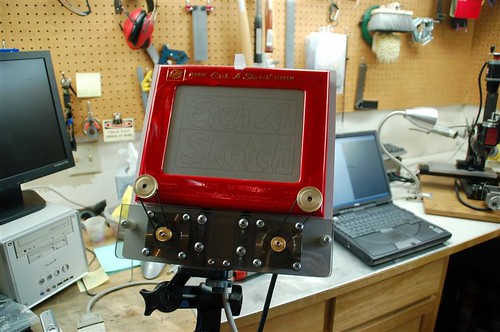
Speaking of kids’ toys, by the way, I stumbled across a pretty impressive project involving a kid’s toy over at I Make Stuff, where the blogger interviewed a guy who usually makes "robots that kill other robots" but recently did something pretty cool with an Etch-a-Sketch.

I had one of these growing up, but could never make a decent picture with it. Little did I know that all I needed were some pulleys, foot pedals, and a laptop to control it all. But you still have to shake it to wipe out the picture. Check out the video podcast at I Make Stuff, recorded at Seattle Battle Bots IV, as well as  more pictures of the CNC controlled Etch-a-Sketch.

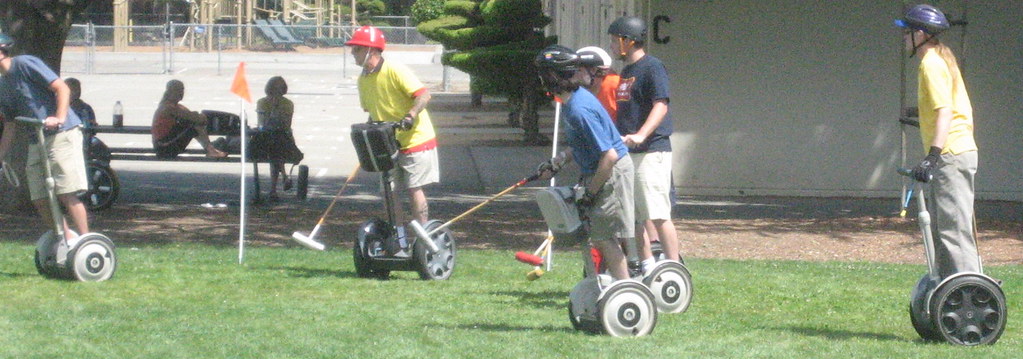
Oh, and if you’d prefer something that’s not only cool but useful as well, DIY Happy has a link to instructions on how to build your own Segway-like scooter. I had a scooter growing up too, but nothing like this. There’s video there as well, and details on the version 2 of the scooter includes an amusing picture of some people engaged in a game of Segway Polo.

GPS Tracking for Parents

Thursday, April 13th, 2006

Before I had a kid of my own, I used to shake my head at parents who used "tethers," that looked like old fashioned telephone cords, to keep their toddlers from toddling off in public. Three years into parenthood, I haven’t succumbed to the "urge to tether" yet, but I’m a little less judgmental about the whole thing.

I have enough trouble keeping up with my three-year-old now. I’m already wondering how I’m going to keep up with him when he’s a teenager with enough subway fare to go where he wants. The answer is simple than I thought: GPS. If it can help find lost pets, it ought to work with kids too. So, though my little one isn’t big enough for a cell phone yet, I was relieved to read on Mobile Wireless News that Sprint just rolled a GPS-driven kid locator service for parents.

Using the Global Positioning System, the service allows parents to track up to four cell phones over the Internet or on their own wireless device. Parents can periodically ask the service to find the child’s phone, displaying the location on a road map.

Parents can also set alerts, automatically warning the parent if the child isn’t at a certain place, such as school or soccer practice, at a specific time.

The child’s phone also displays a text message, letting the child know they’ve been searched for and found.

Of course, there are other uses, like keeping track of elderly parents (as the article notes) or keeping tabs on a wandering spouse, which leads to charges that Big Brother is in the house.  I guess there’s two sides to every technology, and whether it’s used benevolently or not depends on whose pushing the buttons. But, as a parent, if kids can’t remember to be in the house when the streetlights come on, this seems like a pretty good way to remind them, when yelling down the street isn’t an option.

A Gravity Powered Plane

Thursday, April 13th, 2006

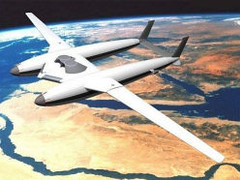
In an effort to create a truly zero-emissions vehicle, Nevada-based Hunt Aviation is exploring ways to use gravity as a powersource– for an airplane:


In order for the GravityPlane to become airborne, gas bags inside a pair of rigid, zeppelin-like structures are filled with helium from storage tanks inside the vehicle. This causes the aircraft to become lighter-than-air, and it rises from the ground. Compressed-air jets on the sides of the craft add further propulsion, pushing the vehicle skyward and decreasing the craft’s overall weight by releasing the stored air which acts as ballast. Once the craft reaches the altitude where the helium is no longer lighter than the surrounding air– theoretically as high as ten miles up– it is unable to climb any further. Some of the stored compressed air is then expanded into the dirigible areas, decreasing the buoyancy effect of the helium and starting the aircraft’s descent phase.

Hunt Aviation has a video explaining the concept of how the plane works. On one level it’s a simple idea– combining lighter-than-air technology to get the vehicle aloft and then gliding from extreme height to the destination. But the devil, as they say, is in the details, and the video reveals the technical complexity that is often involved in implementing a "simple" idea.

Commenters at this blog were relatively unimpressed by the concept. What do you think? 

Happy Anniversary

Tuesday, April 11th, 2006

Apollo 13

apollo13

It was yesterday. Did you remember? I didn’t until until Transterrestrial Musings reminded me, but I usually don’t remember anniversaries. At least this time I don’t have to buy flowers on my way home, but a movie night may be in order.