Archive for the ‘Business Network’ Category

Happy Anniversary

Tuesday, April 11th, 2006

Apollo 13

apollo13

It was yesterday. Did you remember? I didn’t until until Transterrestrial Musings reminded me, but I usually don’t remember anniversaries. At least this time I don’t have to buy flowers on my way home, but a movie night may be in order. 

To Mars and Back – In One Day

Tuesday, April 11th, 2006

Ever hear that something is “physically impossible?”  It carries a lot more weight coming from physicists. How do you respond? Can the speed of light be exceeded?
 
According to an annual award presented by the American Institute of Aeronautics and Astronautics, the fanciful dreams of interstellar travel using a real “hyperdrive” might indeed be possible. Based largely on the work of the late Burkhard Heim, a theoretical physicist whose advanced theories still baffle most physicists today, we could be on the verge of a propulsion revolution:

 
This paper is the third one in a series of publications, describing a novel and revolutionary space propulsion technique, based on a unified field theory in a quantized, higher-dimensional space, developed by the late Burkhard Heim and the first author, termed Heim quantum theory (HQT) in the following. It is interesting to note that this theory shares a similar physical picture, namely a quantized spacetime, with the recently published loop quantum theory (LQT) by L. Smolin, A. Ashtektar, C. Rovelli, M. Bojowald et al. [11, 24-28]. LQT, if proved correct, would stand for a major revision of current physics, while HQT would cause a revolution in the technology of propulsion.

 
The paper, “Guidelines for a Space Propulsion Device Based on Heim’s Quantum Theory,” goes into considerable detail. What got physicists buzzing in January was a piece in New Scientist, overwhelming all who are familiar with Heim’s work with hundreds of questions and unprecedented attention.
 
It’s this type of game-changing new science that NASA was looking for. The story was picked up by The Scotsman, interviewing some who worked on the AIAA submission:
 

Prof Hauser, a physicist at the Applied Sciences University in Salzgitter, Germany, and a former chief of aerodynamics at the European Space Agency, cautioned it was based on a highly controversial theory that would require a significant change in the current understanding of the laws of physics. "It would be amazing. I have been working on propulsion systems for quite a while and it would be the most amazing thing. The benefits would be almost unlimited," he said.


Some people look at Heim’s work like it came from another planet. Maybe it did.

Propelling through multidimensional hyperspace might afford the possibility of exploring the closest earth-like exoplanet, discovered a couple of years ago, orbiting mu Arae, a sun-like star. The planet is 14 times the mass of earth and is a mere 50 light years away.

Punch the hyperdrive and we can get there in less than 11 years.


Mars, In Color

Monday, April 10th, 2006

Friday saw the release of the first color image from NASA’s Mars Reconnaissance Orbiter.

ABC News reports:

The crisp test images released Friday revealed pocked craters, carved gullies and wind-formed dunes in Mars’ southern hemisphere. The diverse geologic features show the importance of water, wind and meteor impacts in shaping the Martian surface, scientists said.


The orbiter, the most advanced spacecraft ever sent to another planet, reached Mars on March 10 and slipped into an elliptical orbit. Over the next six months, it will dip into the upper atmosphere to shrink its orbit, lowering itself to 158 miles above the surface.

Last month, the orbiter beamed back the first view of Mars from an altitude of 1,547 miles. Those first test images were meant to calibrate the high-resolution camera aboard the spacecraft. The latest images were taken at the same time, but scientists spent several weeks processing them.

The Reconnaissance Orbiter will begin collecting data in November, and scientists expect the resolution of those images to be nine times higher.

The image is in infrared color– so the colors seen in this post are not what would be seen by the human eye.

 For additional information on the above image, click here.


NASA Goes to China?

Thursday, April 6th, 2006

The China story is getting more interesting. I only found out a couple of days ago that China has a space program, and some pretty ambitious plans to go along with it. At the time I wasn’t sure how serious the news was as far as the U.S. space program is concerned. Now I find out, via The Write Stuff again, that apparently it’s serious enough that NASA may send someone to China to check things out.

Chinese space officials have invited NASA Administrator Michael Griffin to visit their country in the fall, possibly as early as September.   

During an informal visit to NASA headquarters in Washington, April 3, Luo Ge, vice administrator of the China National Space Administration, met with Michael F. O’Brien, NASA associate administrator for external relations, to discuss a potential trip by Griffin to meet with Chinese space officials and visit their facilities, possibly as early as September.

“I made a joke with Mr. O’Brien that if we need to get married some day, we have to meet; otherwise we cannot get married,” Luo said in an interview here following his morning keynote speech April 5 at the 22nd National Space Symposium. Luo described the visit with O’Brien as “only a drop in” with two purposes:” to see an old friend” and to discuss Griffin visiting China.

Marriage proposals aside, that’s rather interesting news. Granted, it’s only an invitation, I haven’t heard whether it’s been accepted. But Lou did speak earlier about China’s willingness for space collaboration, and given Tom DeLay’s rather dire warning about the "space race" with China, it might be smart for NASA to at least give the Chinese program the once over; especially considering who else could be entering the "space race." 

If Matt Tompkins over at DefenseTech.Org is right when he says "Don’t Freak" over reports that China is set to overtake the U.S. in technology development, NASA may find it has nothing to worry about.  And with China concerns about its U.S. debt holdings, and  news that Iran is entering the space race too, some kind of U.S. – China partnership could be advantageous for both.

Mind you, I’m just a newbie who’s trying to sort all this stuff out. And I wouldn’t’ mind a little help.

China’s Sputnik?

Tuesday, April 4th, 2006

It’s gonna get crowded up there. In space, I mean. On the moon in particular. And the key to it all may be soon-to-be-former Congressman Tom DeLay. I thought it was down to the U.S. and Sweden in the latest lap of the "space race."  But it looks like there’s one more player entering the arena. I checked my RSS reader this afternoon, and found out via NASA Watch that China has plans for space exploration to the moon and beyond.

A top Chinese space official on Monday described China’s ambitious exploration plans, including robotic Moon missions starting next year.

Beyond Moon missions, including a flight to collect and return lunar samples to Earth in 2017, the Chinese space agency plans to develop a nonpolluting launch vehicle that can lift 55,000 pounds (25,000 kg) into orbit by 2010, said Luo Ge, a vice administrator at the Chinese National Space Administration.

"Space is a high-risk investment," Luo said through a translator at the Center for Strategic and International Studies, a Washington think tank. "China as a developing country is limited and constrained by its funding for more ambitious programs."

But Luo says China has an edge because of the progress of its space program, the country’s "openness" — citing its work with countries like Russia, Nigeria, and Brazil — and because the U.S. has grown more closed since the 1990s. The Write Stuff, space blog of the Orlando Sentinel’, points to a story that repeats Luo’s claims and notes the successes of China’s space program, including a manned spaceflight last October. 

But is there anything to China’s claims? And How does Tom DeLay figure into all of this? 

Jeff of Space Politics reminds us that none other than Tom Delay warned just a week ago that the U.S. is in a "space race" with China, and even called China’s space program "a 21st century Sputnik moment"

I’m not sure I buy that comparison, as it sounds like a bit of hyperbole to me. After all, Luo even noted that China’s $500 space budget is barely bus fare compared to NASA’s $16.6 billion. But then again NASA is losing a powerful backer in Tom Delay, and having to pinch pennies for the moon mission even as scientists are clamoring for more

Plus Jeff also speculates that, since he called for a special oversight hearing on NASA’s human space space program during a congressional hearing last week, the Chinese space program might be one reason for DeLay’s 2-month "delay" in actually leaving office. Maybe ensuring NASA stays well head of China’s"sputnik" will be DeLay’s swan song.

I suppose Jeff could be right. After all, just last week I thought Sweden was America’s biggest competitor in space. They don’t call me NooBee (i.e. "newbie) for nothin’, folks.

NASA & Sweden in Moonbase Race?

Monday, March 27th, 2006

The history book on the shelf,
Is always repeating itself…

Abba – “Waterloo” 

We’ve already been to the moon (unless you believe that the whole thing was done on a movie lot), but it looks like we’re going to stay a while the next time we go back. There just one question. Who’s gonna get there first? I experienced a little brain tickle this morning when I saw the news item that NASA is quietly planning a moonbase

For the first time since 1972, the United States is planning to fly to the moon, but instead of a quick, Apollo-like visit, astronauts intend to build a permanent base and live there while they prepare what may be the most ambitious undertaking in history — putting human beings on Mars.

It sounded vaguely familiar, and not because the presdient announced a plan to return to the moon a couple of years ago. I felt that brain tickle because I remembered hearing just a week or so ago that someone else was planning to do the same thing.

A quick search through my bookmarks, and I had the answer. In the race to colonize the moon, NASA has at least one competitor: Sweden.

The proof comes in the form of the innocent-looking SMART-Centre which, according to various reports, has assembled a consortium of more than 50 partners – including Japan’s Shimizu Corporation, US NASA contractor Orbitech and the UK’s Cranfield University – to turn the centre’s Dr. Niklas Järvstråt’s dreams of extraterrestrial conquest into reality.

 You won’t find much about a moonbase at the SMART-Center homepage. For that you’ll have to dig into their projects for the vision statement.

We have already taken the one small step for mankind and landed on the moon. We have seen it, we have conquered it, we have explored it – but our presence has not been sustained. For the benefit of mankind, the survival of our natural resources on Earth and for the proliferation of space exploration, it is now time for the next logical step – an international lunar colony. A colony where men, women and children can live without the need of a continuous supply of materials and technology from Earth; a self-supporting colony where the great circle of life can be sustained in its entirety by lunar raw materials and where all life-sustaining products will be manufactured in situ.

The Swedes have some other big plans in mind beyond moon — including exploring Mars, asteroids, other solar systems, etc., and trying their hand at world peace — but will it be more than they can handle? Then again, as the article linked above notes, NASA has its hands full with emptying its already-tapped-out pocketbook for space shuttle repairs, with a 2020 back-to-the-moon deadline looming over it. The Swedes have a deadline for lunar construction and immigration to happen sometime between 2018 and 2024.

So, it’s not a question of if human beings will return to the moon, but a matter of when and under which flag. Anyone care to lay bets?
No More Dial-Up to the Outer Planets

Thursday, March 23rd, 2006

It may be surprising to many people, but when NASA scientists receive data back from distant probes, their experience is akin to downloading "Bohemian Rhapsody" (or, pick your own epic-length song) on 56K. Which is to say, there’s a lot of waiting involved. But that could change:

 Researchers at the Massachusetts Institute for Technology have developed a tiny light detector that could one day boost interplanetary communications to broadband speeds.

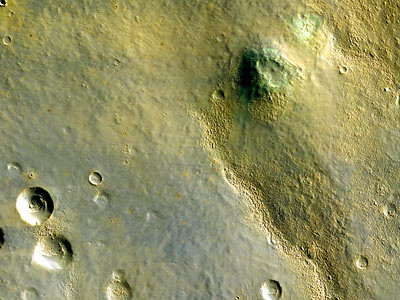
Images from Mars, like this computerized one of a canyon, are transmitted at a data rate of 128,000 bits per second.

The work could permit the transmission of color video between astronauts and satellites and scientists on Earth across interplanetary distances, something that is not practical with current technologies.

The new light detector improves detection efficiency to 57% at a wavelength of 1,550 nanometers — the same wavelength used by optical fibers on Earth to carry broadband signals to homes and offices. Currently, light detectors only absorb about 20% of the light they receive.

"It can take hours with the existing wireless radio frequency technology to get useful scientific information back from Mars to Earth," said study team member Karl Berggren from the Massachusetts Institute of Technology. "But an optical link can do that thousands of times faster."

The work is detailed in the Jan. 23 issue of the journal Optics Express


Mars Probe Set for Arrival

Friday, March 10th, 2006

"The tension is mounting for scientists and engineers of NASA’s Mars Reconnaissance Orbiter (MRO) mission as their spacecraft heads toward a red planet rendezvous today," Space.com reports:

 MRO is expected to enter Mars orbit after a 27-minute maneuver around the planet’s southern hemisphere, completing a seven-month trek. That burn is set to begin at 4:25 p.m. EST (2125 GMT) this afternoon, with MRO swinging back into communications range by 5:16 p.m. EST (2216 GMT).

NASA will broadcast MRO’s Mars approach and orbital arrival live on NASA TV beginning at 3:30 p.m. EST today. You can watch it here

Technorati Tags:  Science, Space, technology, Cool Stuff, NASA, Planetary

Life’s Distant Outpost?

Friday, March 10th, 2006

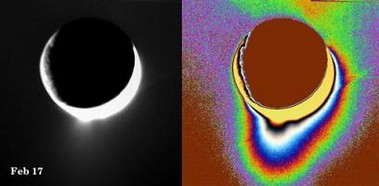
"One of Saturn’s moons, Enceladus, is spewing out a giant plume of water vapor that is probably feeding one of the planet’s rings, scientists said on Thursday," Reuters reports, indicating the potential for biological life on the tiny moon.

NASA made the announcement yesterday, and it quickly became headline news around the world:

The findings, published in the journal Science, suggest that tiny Enceladus could have a liquid ocean under its icy surface which in theory could sustain primitive life, similar to Jupiter’s moon Europa. The plume was spotted by Cassini, a joint U.S.-European spacecraft that is visiting Saturn….

Several moons have been found to have evidence of liquid water and the chemical elements needed to make life, including Europa. But scientists are far more intrigued by the plume itself, a gigantic geyser of water vapor and tiny ice particles.

"It’s basically this giant plume of gas coming out of the south pole of Enceladus," Candy Hansen of NASA’S Jet Propulsion Laboratory in California said in a telephone interview.

"The plume is half the size of the moon. It’s huge," said Hansen, a planetary scientist. "Water is being spewed out of this moon. It solves some real mysteries that we have been struggling with over the years."

Indirect observations had shown the moon, discovered in 1789 by William Herschel, was rich in oxygen and hydrogen. But whether this was because of water was not clear.

Both water vapor and water particles were observed, as well as a smattering of other compounds such as methane and carbon dioxide, the international team of scientists report in a series of papers in Science.

It is possible the plume comes directly from ice, but more likely there is a liquid source, they said. It would have to be under the moon’s surface, which is covered with ice.

"If a wet domain exists at the bottom of Enceladus’ icy crust, like a miniature Europan ocean, Cassini may help to confirm it," Jeffrey Kargel of the University of Arizona at Tucson wrote in a commentary. "Might it be a habitat? Cassini cannot answer this question," Kargel added.

"Any life that existed could not be luxuriant and would have to deal with low temperatures, feeble metabolic energy, and perhaps a severe chemical environment. Nevertheless, we cannot discount the possibility that Enceladus might be life’s distant outpost."

Technorati Tags:  

Science, Space, technology, Cool Stuff, PHYSICS, News, NASA, Planetary

Satellites Track Climate Change

Thursday, March 2nd, 2006

Back in March of 2002, twin satellites launched called GRACE (short for Gravity Recovery and Climate Experiment) were launched by NASA to make detailed measurements of Earth’s gravity field and to the Earth’s natural systems.

Today, MSNBC reports that new data from the satellites reveal that global warming is causing ice loss in Antartica: 


 Joining the growing list of places on this planet that are melting, Antarctica is losing about 36 cubic miles (150 cubic kilometers) of ice every year, scientists reported Thursday.

For comparison, Los Angeles consumes roughly 1 cubic mile of fresh water a year.

The south polar region holds 90 percent of Earth’s ice and 70 percent of the total fresh water on the planet, so any significant pace of melting there is important and could contribute to an already rising sea….

"This is the first study to indicate the total mass balance of the Antarctic ice sheet is in significant decline," said Isabella Velicogna of the University of Colorado at Boulder.

More information on GRACE can be found here