Archive for the ‘Business Network’ Category

Roomba on the Moon?

Tuesday, May 30th, 2006

Saturn’s moon, that is. The first intelligent beings we know of in space (besides us, if we count) may be the ones we make ourselves. If this New York Times article is to be believed, scientists basically want to attach a blimp to a Roomba and send it to one of Saturn’s moons. 
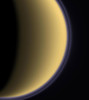
Titan

A future space mission to Titan, Saturn’s intriguing moon enveloped in clouds, might deploy a blimp to float around the thick atmosphere and survey the sand dunes and carved valleys below.

… Until recently, interplanetary robotic explorers have largely been marionettes of mission controllers back on Earth. The controllers sent instructions, and the spacecraft diligently executed them.

But as missions go farther and become more ambitious, long-distance puppetry becomes less and less practical. If dumb spacecraft will not work, the answer is to make them smarter. Artificial intelligence will increasingly give spacecraft the ability to think for themselves.

… HAL, the soulful conversationalist at the helm of the spaceship in "2001: A Space Odyssey," is not on the drawing board. The work so far has been more along the lines of Roomba, the robotic vacuum cleaner, with autonomy to perform certain specific tasks.

Interesting. Just about everybody his brother has hacked a Roomba and/or blogged it. I guess the AI techs at NASA will get their crack at doing the same. 
NASA on Hurricanes

Wednesday, May 24th, 2006

It’s that time of year. Hurricane season is upon us, and NASA is stepping up its services to better communicate with employees through its intranet. Good thing too, because half of NASA’s offices are smack in the middle of the path Katrina and Rita took to land last year. 

The InsideNASA intranet, built on Vignette’s Next-Generation web Presence platform, help employees at 11 US facilities stay informed about office closures, evacuation procedures and when it’s safe to return to work. Information on the site also will guide employees to make a "safe-arrival call" when they reach their destination.

… There’s also a real-time feed from the Department of Homeland Security (DHS) helps monitor theorist threat advisories. The site has approximately 130 portlets, "a small window of content, such as an animated real-time weather map," Holm said. "We also have an announcement portlet that offers all the latest information at NASA submitted by employees."

… A virtual private network (VPN) provides employees remote access from virtually any device with internet connectivity, such as a Research In Motion (RIM) Blackberry or Palm Treo. NASA employees also can call a hotline to find gas or a hotel when there not able to log into the network, Holm said. "Just for my group, we budgeted about US$300,000 for the project this year," she said. "It includes personnel, management training, operations, content and disaster support, and publishing and information architecture."

Makes sense, since NASA has something of an inside track when it comes to advance info on hurricanes. Metroblogging New Orleans posted that NASA’s satellite study of Rita last summer yielded an interesting discovery about what’s behind the strength of some hurricanes.  

Using a satellite last summer to study hurricane Rita from above, scientists discovered that towering clouds near the storm’s eye were good predictors of future storm strength.

… Specifically, if hot towers are active at least 33 percent of the time during a three-hour period, surface winds have an 82 percent chance of intensifying. Making such measurements on the fly could improve the forecast of a storm’s strength just prior to landfall.

Here’s hoping more accurate forecasts combined with getting information out faster will lead to getting more people out of the path of the next big hurricane.

Google Earth Mashup of Kennedy Space Center

Tuesday, May 23rd, 2006

Via Google Maps Mania comes this very cool mashup:

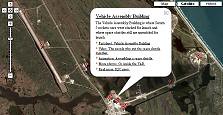
South Florida newspaper Florida Today has built a Google Maps mashup of space launch sites at Kennedy Space Center and Cape Canaveral. It includes a database of every launch since the dawn of the space age, shuttle and rocket launch video and images, and video tours inside facilities people usually don’t get a chance to see guided by its space reporters. It also has an enhanced 3D Google Earth version you can download as well 

The standard 2-D tour is interesting, but if you want an amazing tour experience you’ll want a (warning: highly addictive) copy of Google Earth (available here) to view the mashup.

In either version, you can click on various launch pads and browse photos, videos, and a database of launches, and generally while away a good part of a Tuesday at work.


A Date with Apophis; or, Killer Asteroids

Monday, May 15th, 2006

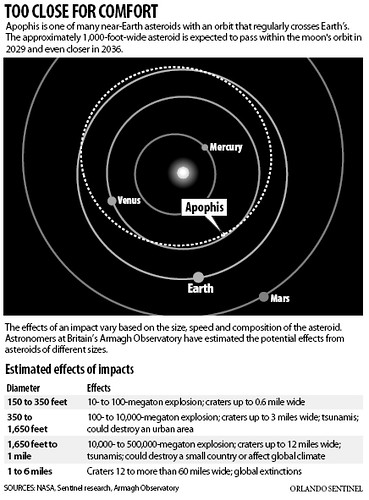
I wouldn’t change your plans yet (though you might want to get busy practicing the Ameriroids game), but Michael Cabbage at the Orlando Sentinel reports on the progress of NASA’s program to identify asteroids that cross the earth’s orbit — and takes a look at the odds of a an asteroid striking the earth in the coming decades:


 Mark your calendar for Sunday, April 13, 2036. That’s when a 1,000-foot-wide asteroid named Apophis could hit the Earth with enough force to obliterate a small state.

The odds of a collision are 1-in-6,250. But while that’s a long shot at the racetrack, the stakes are too high for astronomers to ignore.

For now, Apophis represents the most imminent threat from the worst type of natural disaster known, one reason NASA is spending millions to detect the threat from this and other asteroids….

Objects this size are thought to hit Earth about once every 1,000 years, and, according to recent estimates, the risk of dying from a renegade space rock is comparable to the hazards posed by tornadoes and snakebites. Those kind of statistics have moved the once-far-fetched topic of killer asteroids from Hollywood movie sets to the halls of Congress.

"Certainly we had a major credibility problem at the beginning — a giggle factor," said David Morrison, an astrobiologist at NASA’s Ames Research Center in Mountain View, Calif. "Now, many people are aware this is something we can actually deal with, mitigate and defend against."

In 1998, lawmakers formally directed NASA to identify by 2008 at least 90 percent of the asteroids more than a kilometer (0.6 mile) wide that orbit the sun and periodically cross Earth’s path. That search is now more than three-quarters complete.

Last year, Congress directed the space agency to come up with options for deflecting potential threats. Ideas seriously discussed include lasers on the moon, futuristic "gravity tractors," spacecraft that ram incoming objects and Hollywood’s old standby, nuclear weapons.

To help explore possible alternatives, former Apollo astronaut Rusty Schweickart has formed the B612 Foundation. The organization’s goal is to be able to significantly alter the orbit of an asteroid in a controlled manner by 2015.

For those so inclined, more things to worry about can be found on the NASA Near Earth Object Program website.

Bloggers Blog also has a roundup of other posts on Apophis fron around the blogosphere. 

U.S., India Team Up for the Moon

Tuesday, May 9th, 2006

"Indian and U.S. space agencies Tuesday signed an agreement to put two U.S.-made scientific instruments on board of Chandrayaan-I, India’s first unmanned moon explorer, in 2008, Indo-Asian News Service reported:

NASA will put one mini synthetic aperture radar (Mini SAR) and moon mineralogy mapper (M3) on board of Chandrayaan-I, according to the agreement.

"The objective of SAR is to detect water in the permanently shadowed areas of lunar polar regions, while M3 will map the minerals on the lunar surface and study its characterization," [Indian Space Research Organization (ISRO) chairperson G. Madhavan] Nair said.

Chandrayaan-I will be launched from the Satish Dhawan Space Centre (SDSC) at Sriharikota in southeast India’s Andhra Pradesh, by an advanced polar satellite launch vehicle (PSLV), into a 240-24,000 km earth orbit and placed subsequently in a 100-km polar orbit around the moon, with its own propulsion system.


Super Space Computing = Chess Tourney

Friday, May 5th, 2006


I’m impressed.  Really impressed.  I think this calls for the first space-based human vs. computer chess tournament. Any takers? Check out what our fine computer scientists and mechanical engineers at Los Alamost National Laboratory are cooking up for us: 

Los Alamos National Laboratory has announced funding of a new space payload which dramatically increases on-orbit computational capabilities. The project is jointly sponsored by the National Nuclear Security Administration’s (NNSA) Office of Nonproliferation Research and Development (NA-22), and the U.S. Department of Defense.

The experimental payload will demonstrate and validate technologies offering more than 1,000 Giga Operations-per-second (GOps) processing capability for Software-Defined Radio (SDR) functions in space. SDR is a technology of interest to the military to support tactical communications and to commercial television and radio broadcasting. The payload computer’s signal-processing capability of 1,000 GOps is approximately the same as supercomputers of the last decade, which occupied 50,000 cubic feet and used 50 kW of power. This new payload, by contrast, is designed to weigh 40 pounds and consume only 80 watts, a performance which is enabled by state-of-the-art, 90-nanometer Virtex-4 silicon-chip technology from Xilinx, Inc.


Weather Satellites Launch After Weather Delays

Monday, May 1st, 2006

Seventh time’s the charm, right?


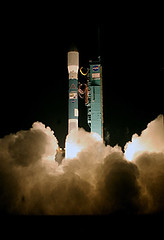
After six tries over eight days, NASA launched a Delta 2 rocket Friday and a pair of satellites that will give planet Earth its newest health checkup by examining the secrets of clouds.

The 12-story-tall rocket built by Boeing rumbled off Space Launch Complex-2 at 3:02 a.m. into foggy skies at Vandenberg Air Force Base.

The approximately $515 million mission placed two satellites into orbit: CloudSat and CALIPSO (Cloud-Aerosol Lidar and Infrared Pathfinder Satellite Observations). About 90 minutes later, officials confirmed that the satellites had arrived in space.

“With the successful launch of CloudSat and CALIPSO we take a giant step forward in our ability to study the global atmosphere," said David Winker, CALIPSO principal investigator from NASA’s Langley Research Center, Va. "In the years to come, we expect these missions to spark many new insights into the workings of Earth’s climate and improve our abilities to forecast weather and predict climate change."

 We wrote about the launch in anticipation on the 20th of April; Rocco kept us updated in the comment threads ("CloudSat can’t launch because of clouds. Go figure."); but now the wait is over, and you can view Friday’s successful launch here.

European Hams Hear Signals from the Edge of Space

Thursday, April 27th, 2006

This one gets filed under "cool stuff," for sure:

Hams in Germany received signals from American spacecraft Voyager 1 March 31 using a 20 meter parabolic antenna of a radio telescope on a frequency of 8.4 GHz….

A team of hams at AMSAT-DL/IUZ Bochum (The Institute for Environmental and Future Research at Bochum Observatory) using Doppler shift and sky positioning, received the signal from a distance of 8.82 billion miles (14.7 billion km). That’s roughly 98 AUs, or 98 times the distance from the Sun to Earth. This is the first recorded reception of signals from Voyager 1 by radio amateurs….

Voyager 1 was launched in September 1977 to conduct close-up studies of Jupiter and Saturn, Saturn’s rings and the larger moons of the two planets. Originally built to last only five years, the probe will continue to send back astronomical information to NASA and the JPL until at least 2020. Voyager 1 will continue to study ultraviolet sources among the stars, and the fields and particles instruments aboard will continue to search for the boundary between the Sun’s influence and interstellar space. Communications will be maintained until the nuclear power sources can no longer supply enough electrical energy to power critical subsystems. 

 The achievement by the German hams makes Satellite Radio seem déclasse.

Sixteen Candles for Hubble

Tuesday, April 25th, 2006

Remember Sixteen Candles, the 1984 John Hughes film featuring Molly Ringwald and Anthony Michael Hall? Hilarity ensued, as they say, when Ringwald’s film family forgot her sixteenth birthday.

We’re thinking of the film as we realize we missed an important date yesterday– the sixteenth anniversary of the  launch of the Hubble Telescope aboard the space shuttle Discovery on April 24, 1990.


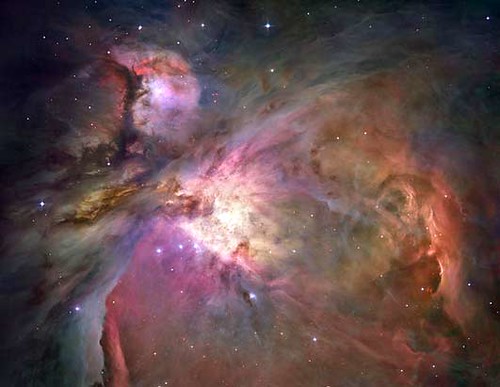
To celebrate the birthday, NASA and the European Space Agency (ESA) have released a "mosaic image of the magnificent starburst galaxy, Messier 82 (M82). It is the sharpest wide-angle view ever obtained of M82, a galaxy remarkable for its webs of shredded clouds and flame-like plumes of glowing hydrogen blasting out from its central regions."

The image can be seen here. Or click here to view a series of other images captured during Hubble’s long life, such as the one above. (This one is  our particular favorite.)
 

NASA Working on Antimatter Rocket for Missions to Mars

Monday, April 17th, 2006


Is science fiction destined to become just science

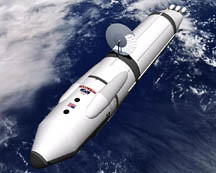
Most self-respecting starships in science fiction stories use antimatter as fuel for a good reason – it’s the most potent fuel known. While tons of chemical fuel are needed to propel a human mission to Mars, just tens of milligrams of antimatter will do (a milligram is about one-thousandth the weight of a piece of the original M&M candy)….

The NASA Institute for Advanced Concepts (NIAC) is funding a team of researchers working on a new design for an antimatter-powered spaceship that avoids this nasty side effect by producing gamma rays with much lower energy….

When antimatter meets matter, both annihilate in a flash of energy. This complete conversion to energy is what makes antimatter so powerful. Even the nuclear reactions that power atomic bombs come in a distant second, with only about three percent of their mass converted to energy.

Antimatter rockets have significant advantages over nuclear-powered spacecraft, including improved safety, efficiency and speed:

The Reference Mission spacecraft would take astronauts to Mars in about 180 days. "Our advanced designs, like the gas core and the ablative engine concepts, could take astronauts to Mars in half that time, and perhaps even in as little as 45 days," said Kirby Meyer, an engineer with Positronics Research on the study.

Advanced engines do this by running hot, which increases their efficiency or "specific impulse" (Isp). Isp is the "miles per gallon" of rocketry: the higher the Isp, the faster you can go before you use up your fuel supply. The best chemical rockets, like NASA’s Space Shuttle main engine, max out at around 450 seconds, which means a pound of fuel will produce a pound of thrust for 450 seconds. A nuclear or positron reactor can make over 900 seconds. The ablative engine, which slowly vaporizes itself to produce thrust, could go as high as 5,000 seconds.

Although one of the drawbacks to antimatter rockets is its high cost of development, we wonder if that can’t be mitigated by passing the hat around to the millions of science-fiction fans around the world, who have dreamed of anti-matter-powered rockers for years.

(Via Rawstory.)