Further Scenes from a Universe
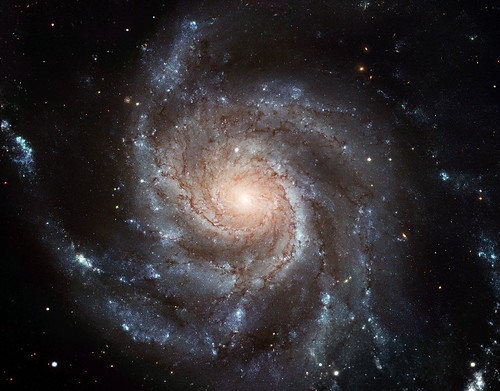
Wednesday, March 1st, 2006This time it’s the Hubble telescope, bringing you the Messier 101 spiral galaxy (a/k/a the Pinwheel Galaxy) head-on, in just 51 exposures and coming in at a mere 16,000 by 12,000 pixels
This time it’s the Hubble telescope, bringing you the Messier 101 spiral galaxy (a/k/a the Pinwheel Galaxy) head-on, in just 51 exposures and coming in at a mere 16,000 by 12,000 pixels
Universe Today has a couple of posts up featuring some fascinting satellite imagery, and even a link to some pretty cool imagination. One features some images of Jupiter, Neptune and Uranus from NASA Astrobiology, while the other concerns a cosmic explosion seen by NASA’s Swift satellite.
The Swift satellite, whose mission control center is in State College, has detected a cosmic explosion that has sent scientists around the world scrambling to telescopes to document this startling event. Gamma-ray radiation from the source, detected on 18 February and lasting about half an hour, appears to be a precursor to a supernova, which is the death throes of a star much more massive than the Sun. "The observations indicate that this is an incredibly rare glimpse of an initial gamma-ray burst at the beginning of a supernova," said Peter Brown, a Penn State graduate student and a member of the Swift science team.
The Penn State release also links to a pretty cool collapsing star animation, collapsing stars being one of the "leading contenders" for causing gamma ray bursts like the one Swift detected. Also check out the link to NASA’s Goddard Space Center for multimedia from Goddard TV.
It hasn’t been long since NASA’s “Stardust” returned to earth, but scientists are already slicing and dicing microscopic specks of comet dust collected by the space probe. We’re talking “dust” that’s as old as the solar system, verified comet matter, seen for the first time by NASA scientists. Interesting stuff. Fortunately, NASA scientists are letting the public in on the fun.
Stardust@Home appears to be modeled after SETI@Home, in the sense that you can volunteer your computer’s unused resources to help with the project by performing mathematical calculations, etc. There’s just one significant difference. They don’t just want your computer’s resources. They want your brainpower too.
First, you will go through a web-based training session. This is not for everyone: you must pass a test to qualify to register to participate. After passing the test and registering, you will be able to download a virtual microscope (VM). The VM will automatically connect to our server and download so-called “focus movies” — stacks of images that we will collect from the Stardust Interstellar Dust Collector using an automated microscope at the Cosmic Dust Lab at Johnson Space Center. The VM will work on your computer, under your control. You will search each field for interstellar dust impacts by focusing up and down with a focus control.
If that sounds exciting to you, and you think you can pass the test, go pre-register to help them out!
If you’ve spent much time on rivers in the Southwest, you know that tamarisk (also known as saltcedar) is a much-hated invasive species– and a threat to the region’s water supply.
Introduced from Eurasia in the early 1900s as an ornamental and erosion-control shrub, it has since spread through most of the Southwest’s riverways (and as far east as Minnesota), choking out native species and crowding out the good cottonwood-shaded beaches that river rafters favor. As well:
The U.S. Department of Agriculture recently identified saltcedar as one of the most harmful invasive species in the United States, because the plant’s long roots tap into underground aquifers. Its groundwater absorbing qualities may be adding to the severity of the drought in the western United States. Saltcedar also increases the salt concentration of the soil and degrades habitats for native species along river systems.
But even low-tech ecological conundrums can be aided by satellite technology. NASA reports:
Products based on NASA Earth observations and a new Internet-based decision tool are providing information to help land and water managers combat tamarisk (saltcedar)… This decision tool, called the Invasive Species Forecasting System (ISFS), is being used at the U.S. Geological Survey (USGS) National Institute of Invasive Species Science in Fort Collins, Colo. It is the result of combining USGS science and NASA Earth observations, software engineering and high-performance computing expertise….. The ISFS uses observations and science data products from NASA’s Terra, Aqua and Earth Observing-1 satellites and the USGS-operated Landsat satellites, together with field data from government and non-government contributors. The satellites observe and measure sunlight reflected by plants and their environments. The satellites lock in on unique aspects of the reflected light to determine saltcedar’s locations and habitats vulnerable to invasion. During the plant’s blooming season, ISFS-generated maps predicting locations match observations of it in the field. These predictive maps are an important new tool for land managers involved with saltcedar-related control and restoration efforts. "Satellite data coupled with computer modeling helps us understand where saltcedar is likely to be growing, even in remote locations that field researchers cannot easily reach," said John Schnase, principal investigator of the ISFS project at NASA’s Goddard Space Flight Center, Greenbelt, Md.
The Tartan Online, Carnegie-Mellon’s student newspaper, chooses Gravity Probe B as its "Experiment of the Week":
Gravity Probe B, a well-endowed NASA/Stanford satellite, is at this moment orbiting the Earth. The satellite’s main feature is its four perfectly spherical, shiny balls. These balls serve as the world’s most perfect gyroscopes, used in an extraordinarily complex and expensive experiment to observe the effects of general relativity…. Einstein’s theory predicts that a rotating massive body should slowly “frame-drag” space and time around with it. Over time, this dragging effect should push the gyroscope’s axis of rotation about 40 milliarc-seconds out of alignment. That’s the width of a human hair as seen from 10 miles. The probe intends to measure this to an accuracy of one percent.
Stanford University, which is working with NASA on the mission, has a mission status webpage that is worth checking out. Also be sure to check out the vehicle tour and the image gallery, featuring schematics of the satellite and pictures of the launch. What other satellite mission websites have you found? Post a link in the comment, or post your own blog entry, and we may promote your link to the homepage.