Archive for the ‘Business Network’ Category

A Sputnik Moment?

Monday, August 28th, 2006

Earlier this month I was somewhat obsessively following the story of China’s space program and U.S. concerns about a looming "Sputnik moment" with China. Well, it looks like using "Sputnik" and China in the same breath may be appropriate as China teams up with Russia for a mission to Mars.

China and Russia are planning a joint mission to Mars that will not only bring samples back to earth but also land on one of the red planet’s tiny moons, a Chinese space scientist here has said.

SputnikYe Peijian, a leading scientist with the Chinese Research Institute of Space Technology, made the announcement at an ongoing forum on China’s space technology development.

Ye said Russia will launch the spacecraft in 2009 and it will carry China-made survey equipment. It will collect samples on Mars and the planet’s nearest moon.

Sun Laiyan, administrator of the China National Space Administration said last month at an international space conference that China is actively planning its deep space exploration over the next five years, focusing on lunar and Mars exploration.

"We will encourage other countries to take part in space science programs initiated by China, and Chinese scientists will participate in international space science programs," Sun said.

The lunar mission definitely jibes with previous reports of China’s space-related ambitions. And the invitation for other countries to take part might bode well for similar U.S. ambitions, in light of China’s earlier invitation to a NASA official to visit the country next month, and check out their space program.

But it sounds like the Russians are already on board. So does this qualify as a "Sputnik Moment" yet?
Cosmonauts to Commemorate Shepard’s Moon Golf with a Drive from the ISS

Thursday, August 24th, 2006

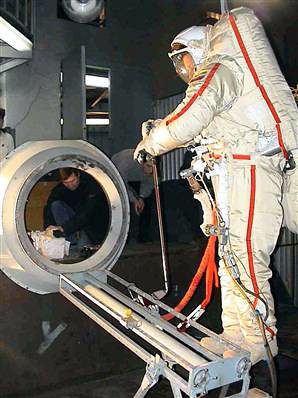
According to the AP, Russian flight engineer Mikhail Tyurin will drive a golf ball back to mother earth from atop the International Space Station on Thanksgiving Day 2006 in a publicity stunt to promote Canadian golf club manufacturer, Element 21 Golf Co.
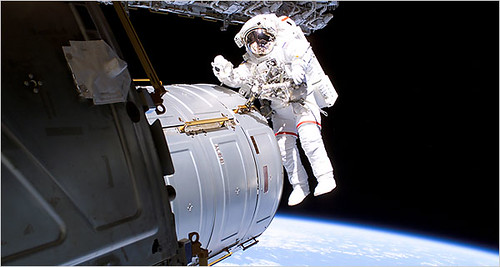
Element 21 asked the Cosmonaut to pull the stunt to publisize its new line of golf clubs and to commemorate the 35th anniversary of the time astronaut Alan Shepard hit golf balls on the moon during the Apollo 14 mission. The stunt, which cost the company an undisclosed amount of money, was originally planned for a June spacewalk, but was pushed back so other tasks could be accomplished.

Oh, and don’t worry about being knocked out by dimpled piece of plastic. The golf ball will most likely return to the earth’s atmosphere in three days, burning up upon reentry.

Oops!: Astronaut Reveals Name of New NASA Spacecraft

Tuesday, August 22nd, 2006

AP:

The name of the new vehicle that NASA hopes will take astronauts back to the moon was supposed to be hush-hush until next week.

But apparently U.S. astronaut Jeff Williams, floating 220 miles above Earth at the international space station, didn’t get the memo.

Williams, through no fault of his own, let it slip Tuesday that the new vehicle’s name is Orion.

"We’ve been calling it the crew exploration vehicle for several years, but today it has a name — Orion," Williams said, taping a message in advance for the space agency that was transmitted accidentally over space-to-ground radio.

NASA planned to reveal the new name Aug. 31, when the space agency also announces which contractor will build the vehicle. Competing for the award are Lockheed Martin and a team made up of Northrop Grumman and Boeing.

You just can’t keep a secret these days. 

Construction to Resume on Space Station

Tuesday, August 22nd, 2006

"For more than three years, the International Space Station has floated half-built above the Earth. Maintained by a skeleton crew, the station — an assemblage of modules and girders — has not come close to its stated goal of becoming a world-class research outpost," the New York Times reports.

But the long break in building out the International Space Station— a result of the grounding of the space shuttle fleet following the Columbia disaster— is about to come to an end:

Since the project began in late 1998 with the joining of two American and Russian modules, the United States and 15 other nations have slowly put together a structure that weighs more than 400,000 pounds, with a habitable volume of almost 15,000 cubic feet. When completed, it is to weigh almost a million pounds and have a cabin volume of more than 33,000 cubic feet, larger than a typical five-bedroom house.

Getting to that goal will require some of the most difficult shuttle missions ever mounted by the National Aeronautics and Space Administration, starting with the Atlantis’s launching from the Kennedy Space Center at Cape Canaveral, Fla [next Sunday]. The shuttle and its crew of six will haul a 30,000-pound, 45-foot truss segment to the station, delicately remove it from the cargo bay and install it during three spacewalks by two teams of astronauts….

NASA has allotted about 15 flights to complete the project before the shuttles are retired in 2010. The next four missions will carry other massive truss segments to extend the station’s central girder to more than 350 feet. The girder will eventually support four huge sets of solar-power arrays, batteries and heat-dispensing radiators.

The additional truss segments, which will increase the mass of the station by 40 tons, will also include 10-foot-wide rotary joints shaped like wagon wheels that will allow the solar arrays to track the sun for optimum power as the station moves in orbit. The Atlantis is delivering the second array, joining one put on the station in 2000.

You can learn more about the International Space Station here

All Hail Hale

Tuesday, August 15th, 2006

We found NASA’s Picture of the Day on Sunday to be particularly fascinating.

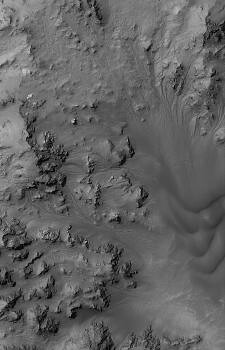
This Mars Global Surveyor (MGS) Mars Orbiter Camera (MOC) image shows dried streambeds—martian gullies— in the mountainous central peak region of Hale Crater. Some scientists have suggested that the fluid which carved these gullies was liquid water, and that it either resulted from ancient snowmelt or from release of groundwater that percolated to the surface in the intensely fractured rock of Hale’s central peak. In either case, the gullies are dry today, and dark sand can be seen as dunes near the right/lower right part of the image.


Blast from the Past: Saving Skylab

Friday, August 11th, 2006

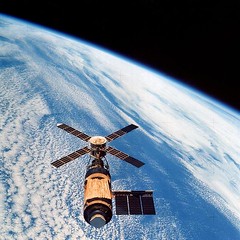
Although Skylab, America’s first space station, fell back to Earth more than 17 years ago, the full-size training mock-up of Skylab is still intact — although in incredible disrepair (and inhabited by several raccoons) —  outside the U.S. Space and Rocket Center near NASA’s Marshall Space Flight Center in Hunstville, Alabama.

Now, a group of volunteers has launched the Skylab Restoration Project with the goal of restoring the training module to its former glory. CNN reports:

Tom Hancock, a board member of the American Institute of Aeronautics and Astronautics, is the leader of the project. He said he is working on the restoration for people like his 18-year-old daughter.

"It’s history. It’s a chance for people my daughter’s age to kick back and see what it was like when I was young," said Hancock.

Made primarily from spare parts left over from the Apollo program, Skylab orbited the Earth for six years beginning in 1973. It helped pave the way for science projects aboard the space shuttle and the International Space Station currently in orbit.

Astronauts learning to live in space trained in Skylab mock-ups at Marshall and the Johnson Space Center in Houston. Three crews of three astronauts each spent a total of 171 days in Skylab, which re-entered the atmosphere in a fiery blaze in 1979.

The Skylab mock-up was displayed for years inside the Space and Rocket Center. But exhibits change, and it was eventually moved outside to a back lot.

 The Skylab Restoration Project is seeking volunteers in the Huntsville area and donations to assist with the project. Visit SaveSkylab.org to learn more and to see "then and now" photos and videos of the Skylab training module.

James Van Allen, 1914-2006

Thursday, August 10th, 2006

In the annals of rocket science, there are few names that loom larger than James Van Allen. 
Van Allen, who came to national prominence with the launch of the first U.S. satellite Explorer 1 in 1958 and who "made the first major discovery of the early space age," died yesterday in Iowa City, Iowa at the age of 91.

A geiger counter developed by Van Allen was attached to Explorer 1, and data sent back by the counters indicated the existence of two belts of charged particles trapped by Earth’s magnetic field — which became known as the Van Allen Belts.

The Telegraph has more on this remarkable man:

The Van Allen belts were discovered by instruments designed by him and carried into space by Explorer I, America’s first satellite. The success of the launch of the 31 lb rocket gave America’s space mission a badly-needed boost after the Soviet Union’s propaganda coup with the Sputnik programme, and Van Allen was featured on the front cover of Time magazine in 1959….

An entire academic discipline, that of magnetospherical physics, owes its existence to Van Allen’s discoveries.

 From the beginning, Van Allen had been keen not only to ensure that rockets were successfully launched, but that they should provide information about aspects of the Earth. In 1950, in conjunction with the British geophysicist Sydney Chapman, he originated plans for an international scientific study of the planet which culminated in the International Geophysical Year (1957-58) of which the satellite programme was the most visible and successful element.

Explorer I’s launch in January 1958 was followed by two further rockets in March, carrying a cigarette-sized "magnetic tape recorder" devised by Van Allen. Explorer IV followed in June, and confirmed the existence of a radiation band 250 miles above the Earth.

He then supervised the Pioneer 10 and 11 rockets, which studied the radiation belts around Jupiter in 1973 and 1974, and went on, five years later, to do the same for Saturn, work which he described in his book First to Jupiter, Saturn and Beyond (1981). He continued to survey the results of the Pioneer and Mariner programmes over decades.

He was also a significant force in the interplanetary missions to Venus, Mars, Neptune, Saturn, Venus and Uranus, contributing to the Voyager programme and the Galileo spacecraft. Much of the knowledge which we now have of the electromagnetic forces, plasmas and radio signals in the solar system derives from the instruments which Van Allen devised and supervised.

 Additional news stories and obituaries can be found here.


The Missing Moonwalks

Monday, July 31st, 2006

A couple of weeks ago, I posted about the dual anniversaries of the Viking I landing on Mars and the first humans (Neil Armstrong and Buzz Aldrin) to walk on the moon. Well, NPR has video footage of Armstrong’s and Aldrin’s lunar jaunts. The only problem is that they’re pretty shoddy copies. So NPR is looking looking for the original footage.

LandingAlmost everyone on the planet who had access to television watched the first moon landing, back on the night of July 20, 1969. What the TV viewers didn’t know is that they weren’t seeing the best images.

The astronauts actually beamed higher-quality footage back to Earth, but it was only seen by a small number of people at three tracking stations.

Those original images were recorded and put into storage — somewhere. Now, a small crew of retirees, space enthusiasts, and NASA employees are searching for a moon landing that the world has never seen.

The NPR piece goes on to describe how the images most Americans saw on their televisions sets back in 1969 were so degraded — compared to what the folks in Houston’s mission-control saw — and incompatible with television broadcasts that they had to be converted to the right format. Afterwards, the original footage was recorded onto 14-inch reels, which disappeared into the National Records Center in Maryland before NASA brought them to Goddard for "permanent retention." They haven’t been seen since.

The folks from the Apollo team would like very much to see the footage again. Actually, so would I. For the first time, of course.


Happy Anniversaries

Thursday, July 20th, 2006

Pop quiz. Where were you 37 years ago today? Where were you 30 years ago today?

Moon Walk

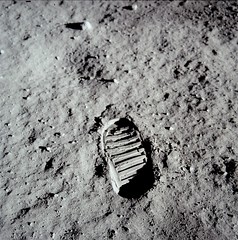
In the first case, I’m not sure where I was, but I was probably learning how to sit up. Meanwhile Neil Armstrong and Buzz Aldrin were becoming the first humans to walk on the moon.

Viking I

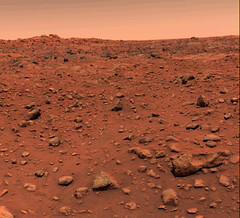
Seven years later, I was walking, talking, and probably getting underfoot around the house when Viking I became the first spacecraft to land safely on another planet.

Via Respectful Insolence and MetaFilter.

GeneBox on Board

Wednesday, July 19th, 2006

It turns out that private spacecraft launch I blogged last week wasn’t exclusively a private entrepreneurial affair. NASA was along for the ride in Bigelow’s balloon, in the form of an experimental micro-lab the agency calls a GeneBox.

Bigelow

The space agency sent up a so-called GeneBox, a micro-lab, with Bigelow Aerospace’s Genesis I last week, piggybaggying a ride on the commercial spaceflight test.

The Genebox is about the size of a shoebox and is attached to the internal structure of Bigelow’s 14-foot inflatable spacecraft, which the company launched from Russia as a demonstration of an affordable human space complex it hopes to launch by 2015. NASA’s GeneBox contains a miniature laboratory of sensors and optical systems that can detect proteins and specific genetic activity. In two weeks, the Bigelow ground control station in Las Vegas, Nev., will activate the GeneBox, and once its tests are complete, data from GeneBox will be relayed to the ground for analysis.

According to NASA, GeneBox will analyze how the near weightlessness of space affects genes in microscopic cells and other small life forms. "During this mission, we are verifying this new, small spacecraft’s systems and our procedures," John Hines, the GeneBox project manager at NASA Ames Research Center in California’s Silicon Valley, said in a statement.