Archive for the ‘Business Network’ Category

NASA Looking to Invest in the Future

Wednesday, November 1st, 2006

According the Washington Post, NASA is getting into the ventura capital biz with a new firm, Red Planet Capital, aimed at investing in start-ups developing emerging technologies that might someday prove useful to NASA. (NASA Watch, of course, had the story in February)

Peter Banks, an organizer and manager of the Red Planet project noted:

"We will invest with others in companies making products that aren’t being made elsewhere and that NASA might be able to use. We don’t really expect the companies to be making products that can be used as is on the moon, or in other low-gravity environments. NASA would do the adapting once the technology is developed."

While this is the first time the "federal government has started a venture capital fund for civilian purposes", its not the first time its utilized the venture capital model of investment for the purposes of government technology development. In fact, the present administrator of NASA, Michael D. Griffin, former president of the CIA-sponsored venture fund, In-Q-Tel, which was very successful in delivering technologies to the Agency… some 130 at last count.

Still, the plan is not without its critics already, some of whom wonder how the federal government can really make it in the cutthroat world of venture capital investing. Blogger Rick Rickertsen doubted, in particular, the usefulness of setting up an investment fund, when present VCs would be more than willing to tell the government what technologies are worth investing in:

"The U.S. has the largest, smartest, best funded venture capital industry on the planet (of Earth). There are hundreds of firms with brilliant technologists investing billions of dollars per year in leading technologies of all types — including private space exploration, which will hopefully put NASA out of business. Why on earth does NASA think they need to add to that? It is truly crazy and beyond wasteful. If NASA wanted a window on technology for the Federal Government, all they needed to do was write a letter to all VCs thought the National Venture Capital Association (Cost: about $200) and all of these good patriots would have sent them every promising business plan in their files. Then they would have had a REAL window on technology."

While Rickertsen may have a point, the success of In-Q-Tel and the fact that Red Planet Capital would basically do just what he requested (asking other VCs to send it the "best" business plans in their files) and then evaluate the quality of those business plans, makes me think that his argument might be a little naive. Oh sure, I imagine VC would be more than willing to send the Feds some pretty slick business plans, spending the next few nights dreaming while federal dollar signs danced over their heads, but to think that they’d do so out of the goodness of their hearts… well, that’s just dumb.
Space Station Unloads Supply Ship; Microsoftie to be next Space Tourist

Friday, October 27th, 2006

With the safe arrival of Anousheh Ansari, the first female space tourist, as we reported a few weeks ago, life continues to be interesting aboard the International Space Station. Today, the Space Stations residents were finally able to open the hatch leading to an unmanned supply shipped that docked with the station 24-hours before. As CBS News reports:

"The Progress M-58 cargo ship, carrying supplies to the station’s three-man crew, docked at the station Thursday at 6:28 p.m. Moscow time (10:28 a.m. EDT) on autopilot, as planned.

Mission Control could not confirm, however, that its antenna had folded as required for the craft to clamp securely on the station although later it announced that it had solved the glitch."

Fortunately, Mission control reports, the crew, which was never in danger of being without food or oxygen, has opened the cargo ship and begun unloading supplies.

In other ISS related news, the billionaire who helped create Microsoft Excel and Word, Charles Simonyi, is supposedly set to be the next space tourist according to the Seattle Post Intelligencer. Simonyi is currently set to join the Space Station crew for eight days (during a ten day mission) aboard a Russian Soyuz spacecraft set to launch on March 9,2007.

Everyone will, of course, be able to follow Simonyi on his travels through his blog at charlesinspace.com.

Lunar Lander XPrize

Monday, October 23rd, 2006


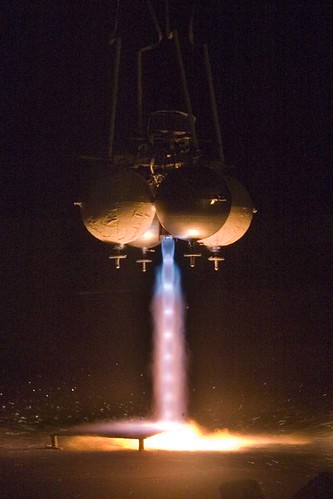
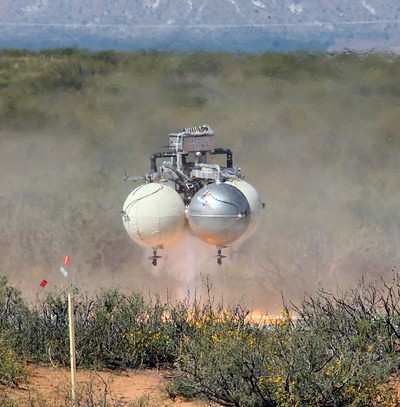
Armadillo Aerospace’s  lunar lander impressed quite a few people at the XPrize Cup in Las Cruces this weekend. Aero-News Net gives this account:

 …the final flight on Saturday, the one that would have earned Armadillo the first tier prize, was frustrated when minor damage done in the previous landing caused a series of events that initiated an inflight abort when the vehicle banked too aggressively shortly after liftoff, and the vehicle went down, damaging itself beyond the ability to fly again.


A Violent Collision of Stars, or a Marriage?

Thursday, October 19th, 2006

That’s the question many are asking when they see this stunning new image of the merging Antennae galaxies taken by the Hubble Space Telescope:


Reuters explains: 

A seemingly violent collision of two galaxies is in fact a fertile marriage that has birthed billions of new stars, and an image released on Tuesday gives astronomers their best view yet.

The new image of the Antennae galaxies allows astronomers working with the orbiting Hubble Space Telescope to distinguish between new stars and the star clusters that form them.

Most of these clusters, created in the collision of the two galaxies, will disperse within 10 million years but about 100 of the largest will grow into "globular clusters" — large groups of stars found in many galaxies, including our own Milky Way.

The Antennae galaxies, 68 million light years from Earth, began to fuse 500 million years ago.

The image serves as a preview for the Milky Way’s likely collision with the nearby Andromeda Galaxy, about 6 billion years from now.

So if you’ve ever gotten the feeling that everything was heading towards a tremendous smash-up — well, you’re right.

You can zoom in on the above image at the HubbleSite


Dust Devils on Mars

Wednesday, October 11th, 2006

This morning we stumbled across this article in the Columbus Dispatch (written under contract by NASA), and we were reminded again of one of the cooler images to come from our solar system in the last few years.

The image is of a dust devil moving across a Martian plain on a hot spring afternoon a year ago:


The image was caught by NASA’s ‘Spirit’ Mars Rover in April, 2005. 

Both rovers (Spirit and Opportunity) have recently been upgraded with new software that enables them to better understand when a dust devil is moving across the martian surface, and to begin snapping pictures when they sense that movement:

NASA’s Space Technology 6 mission, or ST6, had already proven this "artificial intelligence" software in space. ST6 used it to help an Earth-orbiting satellite take pictures of erupting volcanoes on Earth. So NASA knew the software would help Spirit and Opportunity capture images of dust devils.

ST6 is part of NASA’s New Millennium Program, whose job is to test new technologies in space before putting them on NASA missions of discovery.

Other images and video from Mars can be found on NASA’s Mars Exploration Program website. 

The Years Fly By

Thursday, October 5th, 2006

MSNBC reports on the most recent Hubble exoplanet discovery:


WASHINGTON – A recently spied planet orbits so close to its star that a new year comes every 10 hours.

Called SWEEPS-10, the planet belongs to a newfound class of zippy exoplanets called ultra-short-period planets that have orbits of less than a day.

The Hubble Space Telescope recently spotted five ultra-short-period planets, all about the size of Jupiter, in a crowded star field near the galactic bulge of our Milky Way galaxy as part of an exoplanet survey called the Sagittarius Window Eclipsing Extrasolar Planet Search, or SWEEPS. A total of 16 planet candidates were found, all with relatively short orbital periods…

"These are the farthest planets detected so far around some of the faintest stars," study leader Kailash Sahu of the Space Telescope Science Institute in Maryland told reporters at a NASA press conference.

Extrapolated to the entire galaxy, the Hubble results suggest the Milky Way contains at least 6 billion Jupiter-sized planets, researchers say.

The findings are detailed in Thursday’s issue of the journal Nature.

More info and images can be found on the HubbleSite.

Launch Day Monday — Delta II: Good; SpaceLoft XL1: Almost.

Tuesday, September 26th, 2006
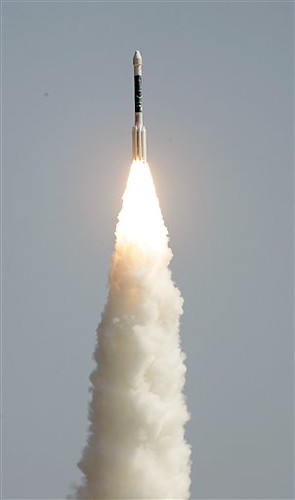
Watched the Delta II launch a GPS payload yesterday, live on HD-Net. Gorgeous launch on a beautiful day at Cape Canaveral Air Force Station in Florida. Seeing it in HDTV does make a difference.

Boeing’s workhouse did its job:

The Delta II rocket carrying the GPS IIR-15 (M) spacecraft lifted off from Space Launch Complex 17A at Cape Canaveral Air Force Station, Fla., at 2:50 p.m. EDT, Sept. 24. Following a nominal 68-minute flight, the rocket deployed the satellite to a transfer orbit.

The Boeing Delta II 7925-9.5 configuration vehicle used for today’s mission featured a Boeing first stage booster powered by a Pratt & Whitney Rocketdyne RS-27A main engine and nine Alliant Techsystems (ATK) solid rocket boosters. An Aerojet AJ10-118K engine powered the storable propellant restartable second stage. A Thiokol Star-48B solid rocket motor propelled the third stage prior to spacecraft deployment. The rocket also flew with a nine-and-a-half-foot-diameter Boeing payload fairing.

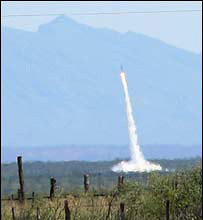
Monday’s other launch event, at Spaceport America in New Mexico, did not do as well. The SpaceLoft XL1 rocket failed at around 40,000 feet, eliciting this gem of a quote from launch logistical coordinator Tracey Larson:

"If it was easy, everyone would be doing it."

NASA Play-by-Play

Thursday, September 14th, 2006

Great piece on NPR yesterday:

All Things Considered, September 13, 2006 · Astronauts working on the International Space Station lost another screw today — but they made it through a seven-hour spacewalk. NASA provided coverage, with commentary, of the entire event. That got producer Jeremy Hobson thinking what it would be like to have a "color guy" to spice up NASA’s coverage.

You’ve got to listen to the podcast yourself.

Complete STS-115 and ISS coverage is on NASA TV.

Shuttle Launch Delayed

Wednesday, September 6th, 2006

Maybe tomorrow? The AP reports:

NASA postponed the launch of space shuttle Atlantis by another day after discovering a problem with a fuel cell early Wednesday.

The fueling process had yet to start when one of three cells that provide electricity to Atlantis malfunctioned. The space agency planned to further examine the problem, and if possible try to launch at 12:03 p.m. EDT Thursday.

"The launch rules say you need to have three good, operating fuel cells," said NASA spokesman Bruce Buckingham. "We’re going to see if it’s something that’s a real problem or whether it’s something we can rectify."

The problem was discovered shortly before an overnight meeting to decide whether to start pumping the shuttle’s fuel tank with supercold liquid hydrogen and liquid oxygen. When the shuttle’s fuel cells were powered up, a low voltage reading came from one of the units, and the other two spiked up to compensate.


Atlantis to Launch Tomorrow at 12:29 pm EDT

Tuesday, September 5th, 2006

The Space Shuttle Atlantis is set to (finally) lift off tomorrow, Tuesday, September 6th at 12:29 pm EDT. NASA’s launch blog should begin coverage of the event around 6:30 am tomorrow.

Weather has twice delayed the start of STS-115. Lightning at Kennedy Space Center on August 25th delayed the previously-scheduled launch, and then the Atlantis crew had to wait out the passing of Tropical Storm Ernesto.

The launch of STS-115 will make history when it carries Heidemarie Stefanyshyn-Piper, the first Ukrainian-American into space. (Be sure to check out her biography or this interview.)

As always, we’ll bring you updates on the launch of the Shuttle as the countdown begins.