Archive for the ‘Business Network’ Category

Space Chickens

Tuesday, July 18th, 2006

With all the talk about Katie Couric moving to CBS to anchor their evening news, which will be promoted on 35 millions eggs, I couldn’t help but notice a news item regarding Congressional testimony asking for help with some COOP.  Get ready for egg jokes.


 
But in this case, COOP stands for Continuity of Operations Planning and the testimony was all about satellite communications as the truly diverse communications path, with the unique ability to link remote locations to the Internet or other private or government network. Hey, if this helps bring down the cost of equipment, I’m all for it. Generally, the U.S. government prefers satcom for many applications, so maybe this is a good approach for  companies such as Hughes and Spacenet.

Now, back to the space chickens. The closest thing we’ve got are the endangered Attwater’s Prairie Chickens, many of whom were relocated to NASA’s Johnson Space Center. Once common in Texas, these birds are a part of indigenous culture. They’re the closest thing we have to space chickens, although they did appear as protagonists in the Muppets movie “Pigs in Space” in 1983. However, one should note the Chinese had the first (somebody had fun with this story).
Rock On for Paint On: Successful Test of “Paint On” Antenna Technology Announced

Tuesday, July 18th, 2006

Who was it that said technology for those who do not understand it is indistinguishable from magic?

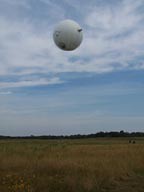
I can’t recall at the moment, but I was reminded of the quote as I read about the successful test flight of an airship utilizing new "paint-on" antenna technology.

NASA’s Langley Research Center, RTI International, Applied EM, Inc., International Communications Group, Unitech, Sierra Nevada Corporation, and Techsphere Systems International, Inc. today announced the successful June 21 completion of the test flights in Nevada.

Azom provides additional details:

The experiment provided the first opportunity to test and evaluate the electrical, electromagnetic and mechanical properties of the "paint-on" antenna technology during an actual flight.

"The successful airship test flights demonstrate exciting possibilities for ‘paint-on’ antenna technologies," said David Myers, vice president of RTI’s Engineering and Technology Unit. "This new technology can be used to assist with hurricane disaster relief, provide enhanced security of ports and borders, perform science observation missions and improve military communications."

High altitude airships can be used for both defense and homeland security purposes including surveillance of battlefields and domestic borders and ports. The airships are intended to serve as economical station-keeping communications and/or ground-sensing platforms that will augment both ground-based and more expensive satellite systems. The airships will operate well above commercial air traffic and the jet stream and beyond the range of most ground-to-air missiles.

In addition to communications, the "paint-on" antennas are a key enabling technology to achieve the high altitudes necessary for Department of Defense and Homeland Security persistent surveillance missions of the nation’s coastal waters, land borders, urban areas and critical infrastructure.

"RTI also arranged for NASA to demonstrate the potential of a lower-cost alternative to satellite remote sensing by installing a GPS Reflectance Remote Sensing Experiment to conduct soil moisture measurements during the flight," according to Azom.

Although it’s certainly a long way off, one can imagine the technology one day applied to the side of your house — eliminating the need for either a satellite dish or (for some of us) the old bunny ears.

It doesn’t even have to look like aluminum foil, apparently.

Discovery Lands

Monday, July 17th, 2006

MSNBC has some good video coverage as well.

Even More Shuttle Video

Tuesday, July 11th, 2006

Just in case you didn’t get enough video in yesterdays post, Phil over at Bad Astronomy points to even more NASA video of the July 4th space shuttle launch, with camera angles from on top and right aft of the starboard solid rocket booster.

The NASA videos area without audio, but here’s a YouTube video of the launch with a play-by-play of the launch.

Monday Morning Videos

Monday, July 10th, 2006

Here’s a couple of videos to get your Monday started with a bang. Via Mars Blog, here’s a NASA video of the STS-121 solid rocket booster separating from the space shuttle. (Can’t view the video? Check out the Flickr photoset of the view from earth.)

Also, a little late for the 4th of July but fun to watch nonetheless, here’s a YouTube video of 30,000 bottle rockets launched in 2 minutes.

How to Deliver Goods to the International Space Station

Friday, July 7th, 2006

After performing a backflip to allow crewmembers of the International Space Station to inspect its belly (and to provide cool images for space fans everywhere), Discovery docked with the ISS yesterday.

The big item on the mission agenda today? Moving supplies

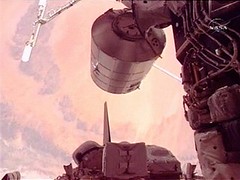
The astronauts moved a huge cargo container, nicknamed Leonardo, onto the space station by robotic arm. Among the goodies awaiting the space station crew were a new stationary bicycle for exercise, an oxygen generator that will eventually allow the space station to support six inhabitants, a machine that cools the station’s cabin air and a lab freezer for scientific samples…

For the first time in three years, the international space station had three crew members. European Space Agency astronaut Thomas Reiter joined Pavel Vingogradov and Jeff Williams, who marked their 100th day at the space station Friday.

The shuttle isn’t the only means of delivering supplies to the ISS, of course. Earlier this week, the European Space Agency announced the successful completion of acoustic testing on "Jules Verne," the first Automated Transfer Vehicle: 

The ATV, an unmanned vehicle that will deliver supplies to the International Space Station (ISS), will be put into orbit by the European Ariane-5 launcher. Acoustic testing is vital to ensure the ATV can withstand the vibrations caused by the extreme noise levels generated during launch.


Discovery’s Launch — From Any Angle

Thursday, July 6th, 2006

MSNBC has a cool interactive web page that allows you to watch Discovery’s July 4th from multiple camera angles. Click here to check it out.

Weekend Roundup

Wednesday, July 5th, 2006

We hope everyone enjoyed the long holiday weekend.

The big non-event of the weekend was the expected near-miss between 2004 XP14 and Earth on Monday:

A large asteroid hurtled harmlessly past the Earth early Monday at a distance of about 269,000 miles – slightly farther away than the moon.

Residents with telescopes in the United States and Canada had the best view of 2004 XP14, which appeared as a streaking dot in the northern sky.

Astronomers tracking the space rock’s path since its discovery in 2004 had determined that it would pose no risk to Earth during the encounter nor in the next 100 years. Judging by its brightness, 2004 XP14 was estimated to be a quarter-mile to a half-mile wide.

An asteroid that size, if it smashed into Earth, would probably cause regional destruction. Scientists have said it would take a mile-wide or larger asteroid to cause widespread devastation that could threaten civilization. 

The big event that finally happened– on July 4th, no less–  was the successful launch of space shuttle Discovery yesterday:

The liftoff, right on schedule at 2:38 p.m., was the start of a 13-day flight that is the first in a year for the diminished shuttle fleet as NASA continues its efforts to resume more frequent human spaceflight.

The Discovery is to rendezvous on Thursday with the International Space Station, where it is carrying equipment, supplies and a fresh astronaut for the station’s crew.

But this is also considered the second and final test flight for the shuttle fleet since the loss of the Columbia and its seven astronauts in 2003, and the Discovery’s ascent was scrutinized for the kind of liftoff debris that caused that disaster.

At 2 minutes 53 seconds into the flight, an onboard camera showed numerous pieces of debris appearing to fall away from the external fuel tank. They fluttered away and did not appear to strike the shuttle, carrying a crew of seven.

N. Wayne Hale Jr., NASA’s shuttle program chief, said the pieces had fallen "after the time we are concerned about," after the air becomes so thin that debris usually floats harmlessly away.

A piece of debris that broke off later in the ascent did appear to strike the midbody of the orbiter, NASA officials said. But they added that it probably did not do any damage.

In all, officials said, insulating foam broke away from five spots on the external fuel tank and a solid rocket booster, some with several pieces of foam.

We’ll be bringing you updates of the space shuttle’s 13-day mission over the next two weeks. 


UFO Threatens Space Station

Tuesday, June 27th, 2006

How’s that for a hyperbolic headline? It’s rooted in fact:

MOSCOW – An unknown floating object close to the International Space Station ISS has concerned ground control, according to reports from the US Space Agency NASA on Tuesday.

The object is approximately 2.8 kilometres away from the International Space Station, said the Russian flight control centre in Moscow, citing a NASA source.

The situation… does not yet require a dodge manoeuvre…..

“The object has no number in the list of space debris,” Kireyev said, according to reports from the Russian Itar-Tass agency.

“It is however probably an old piece of space exploration equipment.”

If the object gets any closer to the ISS, astronauts Jeff Williams and Pavel Vinogradov would have to take the precaution of moving to the rescue space shuttle Soyuz TM.

A dodge manoeuvre could cause difficulties for the docking of the US space ship “Discovery”, due to be launched on July 1.

Perhaps the astronauts should practice on this game.

Nix and Hyrda

Monday, June 26th, 2006

In other Hubble news (see the post below), a pair of small moons orbiting Pluto, first photgraphed by the Hubble Telescope in 2005, now have official names: Nix and Hyrdra.

"Nix and Hydra are roughly 5,000 times fainter than Pluto and are about two to three times farther from Pluto than its large moon, Charon, which was discovered in 1978," according to the official Hubble website.