Frisbee in Space
Monday, December 18th, 2006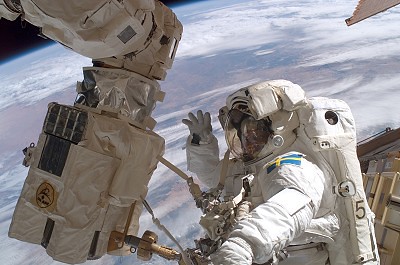
The Swedish astronaut on STS-116, Christer Fuglesang, is a former Frisbee champion back home. Philly.com reports he set a new world record for maximum speed aloft last Friday.
The Swedish astronaut on STS-116, Christer Fuglesang, is a former Frisbee champion back home. Philly.com reports he set a new world record for maximum speed aloft last Friday.
 After a delay due to weather, the Saturday night launch of the Space Shuttle Discovery marked the first shuttle night launch in more than four years.
The Discovery mission involves more than NASA, however: Playing a key role in analyzing the weather and the launch itself was the Air Force’s 45th Space Wing out of Patrick Air Force base in Florida.
Air Force Link provides a unique behind-the-scenes look into the role of the 45th Space Wing in Discovery’s launch:
Several units across the 45th SW played vital roles such as helping validate the pad after the shuttle rolled out, final ordnance installation, providing weather forecasts, organizing and training Department of Defense contingency response forces and media relations.
The wing also provided eastern range support with a vast network of radar, telemetry, meteorological, optical and communications instrumentation that helped facilitate a safe, picture-perfect launch….
Another of the ways the 45th SW supported this mission was monitoring restricted airspace near Kennedy Space Center and helping keep it clear during the launch window.
Staff Sgt. Adam Greer, of the wing’s 1st Range Operations Squadron, served as an aerospace control officer. He closely monitored a radar scope and had the capability to facilitate contacting pilots who strayed into the restricted airspace, if necessary, during the mission.
Sergeant Greer remembers watching space shuttle launches as a kid. He said it’s surreal that he is part of the launch team now.
"The fact that I played a role in space exploration by helping launch a mission to the International Space Station is something that will stay with me forever," he said.
The STS-116 mission is the 33rd for Discovery and the 117th space shuttle flight. During the planned12-day mission, the crew will continue construction on the International Space Station, rewiring the orbiting laboratory and adding a segment to its integrated truss structure.
Click here for more information on the 45th Space Wing at Patrick AFB.
If the weather cooperates, tonight’s launch of the Space Shuttle Discovery could kick off a "rocket finish" to 2006.
At least nine satellite or shuttle launches are scheduled between now and December 31st.

NASA reports from the launch pad at Kennedy Space Center:
All systems onboard the space shuttle are functioning normally this morning, but there’s a 60 percent chance of weather prohibiting a liftoff at 9:35 p.m. EST. A cold front moving through the area is expected to bring with it a lingering blanket of clouds and isolated light rain. The team will press on with the countdown for now, in case the weather cooperates after all.
Starting shortly after 9:00 a.m., Discovery’s orange external tank will begin loading 500,000 gallons of liquid oxygen and hydrogen. This process, called "tanking," takes about three hours to complete. The propellant levels in the tank will be continuously "topped off" until the final minutes of the countdown.
Across the space center, in the Operations and Checkout Building’s crew quarters, the astronauts are scheduled to wake up just as tanking is getting under way. After breakfast, a weather briefing and suiting up, they’ll board the silver Astrovan and leave for the launch pad amid the cheers of Kennedy employees.
The STS-116 mission is the 33rd for Discovery and the 117th space shuttle flight. During the 12-day mission, the crew will continue construction on the International Space Station, rewiring the orbiting laboratory and adding a segment to its integrated truss structure.
But will the weather cooperate? "The forecast has trended for the worse right now," says Kathy Winters, the shuttle’s weather officer.
The weather in French Guiana looks a bit better for tomorrow’s planned launch of Arianespace’s final Ariane 5 mission of the year, which will lift SES-Americom’s AMC-18 satellite. That launch can be seen live in North America beginning at 4:45 pm EDT.
 Well, this sure beats Al Capone’s vault.
The photo to the left shows new deposits of mud, silt or frost on the surface of Mars, which weren’t there several years ago.
As CNN explains:
"The latest research emerged when the Global Surveyor spotted gullies and trenches that scientists believed were geologically young and carved by fast-moving water coursing down cliffs and steep crater walls.
"Scientists at the San Diego-based Malin Space Science Systems, who operate a camera aboard the spacecraft, decided to retake photos of thousands of gullies in search of evidence of recent water activity.
"Two gullies that were originally photographed in 1999 and 2001 and re-imaged in 2004 and 2005 showed changes consistent with water flowing down the crater walls, according to the study."
The Christian Science Monitor has more:
For years, evidence from Mars has supported the idea that billions of years ago, large amounts of water flowed on the planet. Surface-penetrating radar on Europe’s Mars Express orbiter has found large ice deposits several kilometers below the surface.
But the strongest evidence for potential watery habitats today had come from NASA’s Galileo orbiter and from the Cassini orbiter, which is currently touring Saturn and its moons. Galileo’s evidence points to a slushy ocean beneath the thick ice crust of Jupiter’s moon Europa.
Cassini tracked watery geysers bursting from Enceladus, suggesting that this moon of Saturn holds reservoirs of liquid water.
But now, Mars is back on the leader board.
"I think they’ve gotten it right," says Bruce Jakosky, director of the Center for Astrobiology at the University of Colorado at Boulder, of the new results.
The presence of liquid water below the Martian surface doesn’t prove that organisms live there, he cautions. But it does change the discussion.
"People have talked about ancient life, given the evidence for ancient liquid water" turned up by orbiters and surface rovers, Dr. Jakosky explains. And evidence continues to mount that liquid water has been present in the red planet’s geologically recent past. "This is the first piece of evidence that says ‘now,’ not ‘a million years ago,’ " he says.
What is your reaction to today’s announcement from NASA?
We’re eagerly awaiting NASA’s live briefing this afternoon at 1 p.m. Eastern, while keeping our enthusiasm in check with memories of Geraldo Rivera opening Al Capone’s vault.
That said, the rumors that water may have been found on the Red Planet are enticing.
You can watch the briefing live on NASA TV, or check back here this afternoon for the full story.
NASA unveiled plans for building a base on the Moon today:
NASA Deputy Administrator Shana Dale, who is guiding the long-term strategy development effort among 14 of the world’s space agencies, said, "This strategy will enable interested nations to leverage their capabilities and financial and technical contributions, making optimum use of globally available knowledge and resources to help energize a coordinated effort that will propel us into this new age of discovery and exploration."
The Global Exploration Strategy focuses on two overarching issues: Why we are returning to the moon and what we plan to do when we get there. The strategy includes a comprehensive set of the reasons for embarking upon human and robotic exploration of the moon. NASA’s proposed lunar architecture focuses on a third issue: How humans might accomplish the mission of exploring the moon.
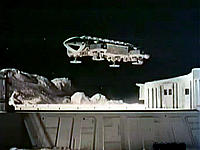
I can’t help it: every time somebody mentions going to the Moon, I think of the British sci-fi show from the 70’s, SPACE:1999. You can still buy the videos on Amazon.
It begins with the Lunar Reconnaissance Orbiter in 2008. This is going to be a pretty cool mission.

Maybe NASA Watch didn’t mean any disrespect when it said in an editors note a couple of weeks ago that,
"Sources inside the development of the Ares 1 launch vehicle (aka Crew Launch Vehicle or "The Stick") have reported that the current design is underpowered to the tune of a metric ton or more. As currently designed, Ares 1 would not be able to put the present Orion spacecraft design (Crew Exploration Vehicle) into the orbit NASA desires for missions to the ISS. This issue is more pronounced for CEV missions to the moon."
But Jeff Hanley, the manager of NASA’s Constellation Project which is responsible for developing the rockets and spacecraft the United States is building to replace the space shuttle and return to the Moon, took it as a "Yo Mama" joke gone too far and responded to the allegations as if the blog had broken his slide ruler just for the fun of it.
As he said in an email sent Nov. 13 and circulated far beyond NASA in the hours that followed:
"[M]any who carp from the sidelines do not seem to understand the systems engineering process. They instead want to sensationalize any issue to whatever end or preferred outcome they wish."
Ooooo, how do you like ‘dem apples NASA Watch?
According to a Nov. 15 Space News Interview, Hanley wanted to make sure that the critics of the program (e.g. that trash talking NASA Watch) got his message.
"I thought it was important that we set the record straight on some of the external stuff that’s been going around. I don’t want people to think that because they don’t see us responding to it on a regular basis that has any basis in truth."
For their part, Space Watch editor recognized the effort Hanley went to to make sure they got his message… and see it as a pretty chump move.
"Jeff Hanley went to great lengths to make certain that I got his email. The way he did so (I have the original distribution list) makes me wonder why he was so eager to use other people to get his thoughts to me – but not do so himself – either directly – or through PAO. Moreover, if Hanley holds PAO- accredited news sources such as NASA Watch in such distain, one wonders why he’d even bother to reply in the first place. Just one of life’s little mysteries, I suppose."
Awww, snap. Who said NASA wasn’t a little like high school?

This was really cool. Thank you, NASA:
Images from the world’s first high definition television (HDTV) broadcast from space flashed across the screen yesterday in Times Square. On Nov. 15, 2006, NASA made history with the first live HDTV broadcasts from space, in cooperation with the Japan Aerospace Exploration Agency, Discovery HD Theater and Japanese broadcast network NHK.
The two HDTV broadcasts featured Expedition 14 Commander Michael Lopez-Alegria on the International Space Station, with Flight Engineer Thomas Reiter serving as camera operator aboard the 220-mile-high laboratory.
"HDTV provides up to six times the resolution of regular analog video," said Rodney Grubbs, NASA principal investigator. "On previous missions, we’ve flown HDTV cameras but had to wait until after the mission to retrieve the tapes, watch the video and share it with the science and engineering community, the media and the public. For the first time ever, this test lets us stream live HDTV from space so the public can experience what its like to be there."
Known as the Space Video Gateway, the system transmits high bandwidth digital television signals to the ground that are not only spectacular, but also valuable to scientists, engineers and managers.
NASA and the Japan Aerospace Exploration Agency, along with both NHK and Discovery, are cooperating in this effort though a Space Act Agreement originally signed in 2002.
Image credit: Discovery Channel
NASA is rolling out the space shuttle Discovery to the launch pad this week for a December 7th launch that will carry Sweden’s first astronaut, Christer Fuglesang, to the International Space Station for a 5-week stay.

The BBC reports on the mission, and Fugelsand’s long journey to space:
In the thick of a complicated series of tasks to rewire the station – hopefully without serious interruption to the resident crew aboard – will be Sweden’s first astronaut, Christer Fuglesang.
He is a 49-year-old particle physicist who joined the European Space Agency (Esa) astronaut corps 14 years ago….
Fuglesang expected to train with Nasa, but found himself on a pioneering assignment to Russia instead. It was 1993 and Europe was preparing for a dedicated research mission aboard the now-defunct Russian space station Mir.
"The toughest part was to learn the Russian language," Fuglesang said. "At that time, we didn’t have any interpreters. There was no material in English. We really had to do everything in Russian."…
German-born astronaut Thomas Reiter, who currently is serving as a crewmember on the International Space Station (ISS), ended up being assigned to the Euromir flight….
Though this will be Fuglesang’s debut space flight, he will have his hands full. Fuglesang is paired with veteran Nasa astronaut Robert Curbeam for the first two spacewalks of the mission.
During the first outing, the pair will install a new external truss segment onto the station’s structural backbone. Two days later, another spacewalk is planned to begin critical work to hook up the station’s permanent electrical and cooling systems.
The ISS mission won’t be all work and no play, however, especially as the holidays approach. Fuglesang already has plans to share some of Sweden’s famous delicacies with his fellow crewmembers:
"Two products that Arla have developed have been approved by NASA and they will feature on NASA’s list of foods that the astronauts can choose from," the Danish-Swedish dairy company said in a statement on Friday.
The two products are a dried milk consisting of lactic pro-biotic bacteria and fruit-flavoured yoghurts that Arla has spent "many years" developing.
Christer Fuglesang, set to be the first Swede in space, has already selected raspberry yoghurt for the duration of the 12-day mission.
Fuglesang hopes to introduce his fellow crew members to other Swedish delights such as dried elk, crispbread and, "seeing as we’re approaching Christmas, gingerbread," the Swedish Space Agency said.
And thus, another first: this may be — as far as we know — the first serving of dried elk on a space mission.
NASA’s Cassini orbiter has recorded something never before seen on another planet — "a hurricane-like storm at Saturn’s south pole with a well-developed eye, ringed by towering clouds."

(Click on the image above to play a movie of the storm.)
From the NASA press release:
The "hurricane" spans a dark area inside a thick, brighter ring of clouds. It is approximately 8,000 kilometers (5,000 miles) across, or two thirds the diameter of Earth.
"It looks like a hurricane, but it doesn’t behave like a hurricane," said Dr. Andrew Ingersoll, a member of Cassini’s imaging team at the California Institute of Technology, Pasadena. "Whatever it is, we’re going to focus on the eye of this storm and find out why it’s there."
A movie taken by Cassini’s camera over a three-hour period reveals winds around Saturn’s south pole blowing clockwise at 550 kilometers (350 miles) per hour. The camera also saw the shadow cast by a ring of towering clouds surrounding the pole, and two spiral arms of clouds extending from the central ring. These ring clouds, 30 to 75 kilometers (20 to 45 miles) above those in the center of the storm, are two to five times taller than the clouds of thunderstorms and hurricanes on Earth.
Eye-wall clouds are a distinguishing feature of hurricanes on Earth. They form where moist air flows inward across the ocean’s surface, rising vertically and releasing a heavy rain around an interior circle of descending air that is the eye of the storm itself. Though it is uncertain whether such moist convection is driving Saturn’s storm, the dark "eye" at the pole, the eye-wall clouds and the spiral arms together indicate a hurricane-like system.
Distinctive eye-wall clouds had not been seen on any planet other than Earth. Even Jupiter’s Great Red Spot, much larger than Saturn’s polar storm, has no eye or eye-wall and is relatively calm at the center.
This giant Saturnian storm is apparently different from hurricanes on Earth because it is locked to the pole and does not drift around. Also, since Saturn is a gaseous planet, the storm forms without an ocean at its base.
Click here to view a movie of the storm.
