Archive for the ‘Business Network’ Category

To Pluto at 52,000 MPH
Wednesday, February 28th, 2007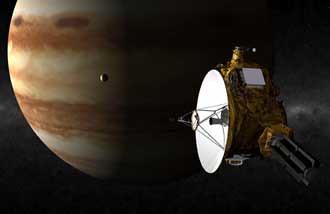
The New Horizons spacecraft used Jupiter’s gravitational pull to increase its speed by 9,000 MPH to a total of 52,000 MPH, as reported by Alex DeMetrick at WJZ in Baltimore:
Heading To Pluto With Help From Jupiter
LAUREL, Md. There are all kinds of test drives, but only one at 52,000 miles per hour.
That’s the speed scientists here in Maryland are aiming for and as Alex DeMetrick reports, the test track is Jupiter.
Man’s first journey to Pluto left a little over a year ago. But for the New Horizons Spacecraft to get there, it’s difficult.
"There’s this little keyhole the spacecraft must reach," Dr. Hal Weaver from the Hopkins Applied Physics Lab said.
That little keyhole just happens to be the biggest planet in the solar system. Jupiter is the spacecraft’s turbo charger, guided by controllers at Hopkins Applied Physics Lab in Laurel.
"We’re using Jupiter as a catapult. By passing fairly close to Jupiter, it’s going to sling-shot us faster toward Pluto. We’re gaining 9,000 miles per hour," Weaver said.
It’s man’s fastest vehicle. While passing by, instruments will be checked out, observations made, including a ride down the planet’s massive magnetic tail.
New Horizons will train its instruments on Pluto in a fly-by in 2015. That’s a long time, but scientists hope it will get there thanks to Jupiter’s assistance.
Not only will New Horizons provide scientists with their first close look at Pluto, the spacecraft will also continue on into the Kuyper belt in search of other Pluto-type objects.
That spacecraft was speeding from the moment it was launched. Watch this launch video and you’ll see the camera operator had trouble keeping up with it:
Ed’s “What’s Next?” Speech
Tuesday, February 20th, 2007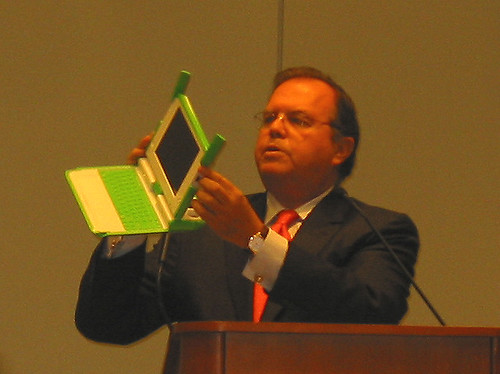
SES AMERICOM CEO Ed Horowitz was the guest speaker at the Washington Space Business Roundtable’s Flagship Lunch and Silent Auction on Tuesday, 20 February 2007.
We don’t have a podcast or video available, so here’s the text of the speech:
“What’s Next?”
I appreciate this chance to speak with you today in this beautiful new facility. Not long ago, as many of you remember, this spot was part of a run down community — which has obviously been brought back to life.
It’s changed.
And — in the midst of the good change around us, I feel it is appropriate to ask, “What’s Next” for our business and for us?
Where will we be in 20 years?
Will we be in 20 years?
I subscribe to Stanford’s “Growth Theory” economist Paul Romer’s view that growth occurs whenever people take resources and rearrange them in ways that are more valuable”.
To know what is “more valuable” is a matter of vision.
At the Twenty-second Communist Party Congress in 1961, Soviet Premier Nikita
Khrushchev’s vision was that within 20 years the Soviet Union would out-produce the United States in all the traditional sectors of industrial might — coal, steel, cement, fertilizer and so on.In 1981, that vision was indeed fulfilled: that year the Soviet Union outdid America in every one of those industries.
They successfully reproduced a late 19th, century manufacturing based industrial economy…while the US was inventing a 21st Century chip, computer and information based economy.
A new world happened, shaped by a furious and unplanned burst of technological, cultural and economic force.
The Soviet vision of the future was as over-confident, but more importantly it was simply — over.
Nikita Khrushchev saw the future through the wrong end of a telescope where the moment seemed larger than it was — and the horizon smaller. He believed he could outwit history with a good plan built on dedicated incrementalism which had one gear — sideways.
As we meet today and at other conferences persistently speaking —to each other —my fear is that we might be inclined to use Nikita’s telescope to envision what’s next for us.
The satellite industry, including SES, has dictated broad global changes in other businesses from entertainment to defense; from detection and GPS to secure communication.
Today, the satellite business is producing reliable earnings for our shareholders. But undeniably, there are changes on the horizon dictated, if nothing else, by the changing worlds of our customers…. And they expect us to “get it”. They expect us to anticipate needs.
What the future holds is an exciting mystery. But, we are better off addressing possibilities while we have a chance to invest in them; to own them —-rather than to ignore or possibly be displaced by them. That’s what we will talk about today.
What we know is that the future will be vastly different.
It is estimated that within the next 25 years, science and technology will advance by a factor of 4 – 7x beyond the advancements over the last 25 years.
While we may hear this in stride — it is absolutely stunning in its business and social implications.
It means that where we stand today on the technology and science scale versus where we will be in the next 25 years — is a moment equivalent to being in the year 1650.
Think about it …1650!
Of course the 25 years from 1650 – 1675 saw their own dramatic developments. The English started drinking tea. Cromwell dissolved Parliament, and the first bank note was issued in Sweden.
During this time the world population expanded to 500 million, which is about one-third the size of India today.
Isaac Newton began experiments with gravity and Cheddar Cheese was invented.
The great Plague of London commenced and the English settled in Charlestown, Virginia.
Ice cream was invented and La Grand Vetel, a famous French chef killed himself because Louis the 14th didn’t like the dinner La Grand had prepared.
You could say a lot happened in those 25 Years…But, the world had seen nothing yet.
1650 was 225 years before the phone was invented and…a century and a half before the ratification of the US Constitution.
It was 200 years before Edison was born. It was 200 years before the US population would reach 23 million and China’s population then — was almost the same number as China Mobile’s cellular customers today (about 350 million).
1650 was 307 years before Sputnik and 315 years before the first satellite.
We are all familiar with the advances made in the satellite industry through compression. Well, get ready for the advances in history made by an unprecedented compression of knowledge in the next 25 years.
We’re about to enter “The Great Compression”.
We are looking at the equivalent change of the last 315 years — about to be compressed into the next 25 years.
What does this mean?
It means — for example — that if you are in the transportation business — the worst four words you could imagine for your business — may actually be heard in the next 25 years…The four words? — “Beam me up Scotty”.
The odds that the massive changes coming in the “Great Compression” will leave the satellite industry untouched — are zero. Change will come to us whatever we choose to do or not to do.
What will we be doing when it comes?
While technology is a “business”, it is also a force not to be controlled even by the best of intentions.
The genie is out of the bottle and the question is whether the genie is working for us or are we working for the genie?
Let’s spend a little time today on some broad issues of concern to our industry and to our customers:
1. U.S. Government business…
2. The commercial and media business…
3. The ramifications of change in both worlds and lastly …
4. I want to discuss a looming talent deficit as we face the coming “Great Compression”.
The US government business is, as you all know, changing rapidly. Saddam Hussein invaded Kuwait in August, 1990 and the US and Coalition forces liberated it in January of 1991.
During the 5 ½ months between Hussein’s invasion and ours, the American military was caught without the satellite capacity to track and mount the offensive.
They scrambled to acquire the needed transponders and didn’t have time for emergency appropriations to acquire them, so the costs were guaranteed —- by Private Citizen Ted Turner.
It was no coincidence that Turner’s CNN had the best and for a time the only video from Desert Storm.
The US military will never be caught like that again. Six months after our troops landed, DISA was created to make sure it wouldn’t happen again.
In the intervening years between Desert Storm and 9/11, the US military changed.
When 9/11 came, the military was ready with a system in place to fund $78 million dollars worth of contracts to provide the satellite and communications services needed. The contracts were in large part for bundled solutions in addition to the broadband commodity.
We learned then that in the future we need to leverage what only satellites can provide — advanced mobile communications and high speed internet access — while on the move —-anywhere in the world — via aircraft, boat, humvee or on foot.
What the military needs is megabytes, not megahertz. The military expects a ground and mobile capacity consistently capable of facial recognition.
Increasingly, the US government wants net-centric bundled solutions as well as broadband and they are calling upon us to be creative about it.
There is a demand for specific megabyte capacity per war fighter and we also know that this demand will only grow over time.
Increasing our military business means persistently increasing capacity and solutions.
For example, there is an ever expanding need for video teleconference capability (VTC) — for commanders in the field, in Washington, and for soldiers on the ground.
The invasion of Iraq was witnessed live on multiple screens in the White House Situation Room. Decisions could be made in real time with real data. Before that it was almost like Abraham Lincoln waiting for a telegram telling him that Grant had taken Richmond.
Soldiers on the ground also have growing “human terrain” needs in addition to VTC — also things like IM and secure chat capability.
Remember, in five years … 50% of the military will be Gen X and Y. They grew up in a digital world. The military has to grow with them – and so do we.
Whenever we speak of high speed mobile communications we must, in the same breath, speak of advanced development of “in-orbit” flexibility and new antennae development.
Satellites must increasingly have capabilities for re-direction and re-programming in space.
We must advance efforts to change frequencies and footprints in orbit.
We look over our shoulders for our competitors and can’t see some of them because they’re in front of us. They may not even be in our business.
For example, let’s look for a moment at the world of Nano-technology, once viewed as science fiction, but today may represent the “key enabling technology” of the 21st century.
Nano- technology is the “purposeful creation, manipulation and use of matter, physical structures and engineered devices with previously unimaginable dimensions”.
Nano-technology is starting to impact chemistry, biology, applied physics and medicine. The inevitable applications to the space and satellite world are just beginning to be imagined.
But, one way to think of it, knowing that a nanometer is one billionth of a meter, is to see every person as a nano-unit in a world with six billion people. That is the level of services and connection we must contemplate.
What are some of the ramifications of these great changes for our customers and for our business?
One ramification could be friction with our current customers and we have to think about that.
Many of our major customers are in the commercial media world — where things are also changing at a furious pace.
You Tube, MP3, file sharing and a host of other technological and social changes are threatening old business models like “Beam me up Scotty” would threaten transportation.
Our media customers are losing control of their customers who are increasingly less dependent on mass packaged media which we reliably deliver.
User generated and niche media (nano media) are replacing mass media.
Remember the 1998 Jim Carrey movie, “The Truman Show” where an unsuspecting insurance salesman’s life was made into a 24/7 movie for the entertainment of the town’s people?
Everyone in his fabricated town, his mother included, made a fool of him everyday — in their controlled entertainment world.
It was all run out of a network studio from which Truman eventually escaped– heartbroken.
Now think of The Truman Show in reverse where the insurance salesman watches everyone and anyone all day and all night, as he chooses.
Imagine control gone from the entertainment business into the hands of Truman… and the walls of the entertainment and media world come tumbling down.
That’s where we’re headed — along with our customers. User generated content and demand is going to turn the media world upside down.
Control will shift and it will be a new challenge to make an honest buck for the old institutions.
What is the response of the media and entertainment business to this creative destruction threat?
A recent book called “Wikinomics” – gives one example of how the media world is responding in the field of music… and I quote:
“Rather than embracing MP3 and adopting new business models, the industry has adopted a defensive posture. Obsession with control, piracy, and proprietary standards on the part of large industry players has only served to further alienate and anger music listeners…If your invention can be replicated at no cost, why should anyone pay?…Today a new economic model of intellectual property is prevailing”.
What is our response?
In the commercial and media world, let’s look at two business prospects on extreme ends of the continuum.
On one end, is the real prospect for business in the under and un-developed world. Half the world does not participate in the global economy in any way shape or form.
The developed world is increasingly understanding the value of changing this through governmental, private and NGO enterprises. It is not strictly a charitable exercise but a way to grow demand and markets.
The economy cannot be called global until this succeeds on a much greater scale. Central to these prospects are enterprises within our expertise. The sooner undeveloped countries have access to the information and communication revolution which, in many ways we can steer, the sooner there will be unprecedented growth and demand not evident in mature economies.
An example of how we extend the reach into being called “truly global” may be characterized by SES’ support of One Laptop Per Child (OLPC) Initiative.
OLPC is designed to put into the hands of children around the world the capacity of accessing information and connectivity with others ranging from people in their village or nearby villages, anywhere in their country and potentially around the world.
On the other end of the continuum are the possibilities in the media world with the disruption of old models.
But before we go any further, let’s make something clear. When we say “user generated content” we all think of You Tube or something like it. But You Tube makes no money and never has — except for its original creators who profited handsomely when they sold to Google.
When Google purchased You Tube and was asked how they intended to monetize it, the answer was: “we’ll figure that out later.”
Let’s be honest. You tube content is dominated by really, really bad material —and the most frequently viewed material inclines toward quality production and content.
But, as you have seen, Viacom is now demanding that You Tube remove all of its Viacom material. Others will surely follow. And You Tube’s offerings will begin to diminish.
Then there is Current TV, Vice President Gore’s effort, which is totally user-generated content. But it’s still part of the standard Dish and cable mass media package.
It’s user-generated content but it’s still part of the old business model for the system providers.
From our point of view, the revolution may have little to do with user generated content and everything to do with user “dictated” content.
I’m talking about free enterprise — for real.
Very recently, an outfit called Virtual Digital Cable in Illinois, has started a service to deliver cable programming without cable — by using only the internet. No trench digging or coaxial cable or fibre placement… no local franchise or fees. Naturally,
the legal challenges to VDC are blocks long but the point is Disruption for our customers and for us — is inevitable.Product development and innovative bundled Solutions like IP Prime are important targets. But how do we most effectively and most profitably adapt to the new net-centric content world?
One answer is to consider what I called “My Geosynchronous Media” but someone told me that MGM was taken. Then I tried “My TV” but of course, MTV was taken. So for now let’s just call it “My TV Station”. “MTVS”
MTVS is a niche media for one; a nano niche.
It is the creation of a net-centric and net- neutral, trusted third party content aggregator designed as “My TV Station” which runs exactly what you want, when you want it on whatever device you choose.
The customer pays only for the exact content they want… whether it’s sports or Friends re-runs, all CSI or whatever. MTVS delivers it and pays the content provider — as a trusted 3rd party must.
Unlike cable and traditional satellite mass programming where you pay for things you never watch, MTVS gathers exactly and only what one person wants to watch when they want to watch it.
This direction means we would become a “Relationship Management” business in addition to our conventional business.
It also means we would, to an unavoidable extent, be in competition with our current customers.
Does that matter? Of course it does. But, these are the kinds of questions we need to face now before it’s too late to do anything about it.
My last issue is “People”. Are the Human resources and talent out there? Can we keep what we have and get what we need? What about the Demographic Wall?
Business Week Magazine recently advised new professionals to stay away from the space business because it offered “no future”. The engineering and science expertise that is the fundament of our industry is aging and this means on one hand that many are near retirement with a thin bench of possible replacement.
On the other hand, those who choose to stay in the business, and we need them desperately, are making it hard for new people we do attract to move up —- and also difficult to make change.
The truth is that as we move forward, this is not your “Father’s Satellite” world.
When it comes to attracting talent, you could say, we have an image problem natural to a maturing industry and …we have an advancement opportunity problem for the ambitious new engineer we do attract.
It is the science and invention that makes us grow. There is a clear shortage on the horizon. It is also true that as an industry, we have very poor public communication and we tell no exciting stories which we need to attract talent.
Just as the American military will be 50% composed of X and Y Gen soldiers who grew up in a digital world, my fondest hope for our industry is that we can say the same. If we can’t –then the future will be a lot harder to face.
I have shared some things to think about with you today and I appreciate your listening to them. I’m glad to hear your ideas as well — any time.
But for now, I see my time is up so I guess all I can say is Thank You and…“Beam Me Up — Frank ”.
Thank you very much.
Ramen in Space… Again, but Now for Longer
Thursday, February 15th, 2007According to one of my favorite space sites, SpaceDaily, Japan is Koichi Wakata, whose a veteran astronaut at the ripe old age of 43, w ill be the country’s first citizen to stay long-term in space begining in the fall of 2008 a three month stint on the International Space Station (ISS).
On his third mission into space (the first happened in 1996, the second in 2000) Wakata will be spending much of his time running a series of experiments in a small laboratory, Kibo (meaning "Hope"), on the multi-national space station. While excited about the opportunity his trip represents, Wakata is even more excited about bringing his nation’s noodles into space.
"’Since I believe that the chances will increase for Japanese astronauts’ long-term stays, I want to check things out such as the clothing, food and accommodation" for future astronauts,’ [Wakata] said.
‘I especially want to try Japanese foods like delicious ramen,’ he said."
Those tasty noodles, invented by the recently deceased Mr. Noodle (right), were originally flown into space on a 2005 US Discovery flight with Japanese astronaut Soichi Noguchi.
Oh, and for those keeping count, according to the Wikipedia, currently 14 of the 193 countries on earth have had representatives visit the ISS so far. Looks like we got 179 to go!
Detecting Debris in Space
Tuesday, February 13th, 2007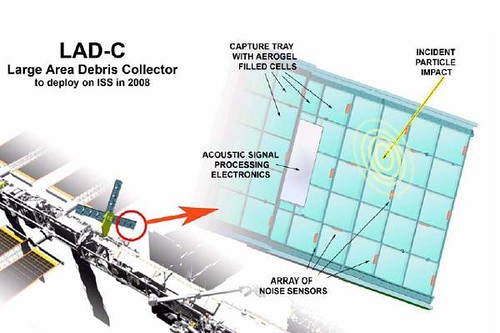
Just last week we wrote about the International Space Station needing to manuever to dodge junk in space — or, specifically, the debris from the disused satellite that the Chinese recently shot down in a military experiment.
Thus it’s a bit ironic, as NewScientistSpace points out, to learn that the "only experiment designed to survey and trace the origin of space debris too tiny to be tracked by radar has been cancelled:"
An international team of scientists had been planning to capture and catalogue this dust from outside the International Space Station with an experiment called LAD-C (Large Area Debris Collector). Meant to be launched on a shuttle in 2008, LAD-C was going to catch the debris in a sponge-like aerogel mounted on a 10-square-metre aluminium grid.
When a piece of space debris hit the aerogel, it would have sent vibrations along the metal grid, where piezo sensors similar to the ones in electronic drum kits would have picked up the signal.
A computer would have registered the location, impact speed and timing of the strike, and based on the orientation of the space station, this would have given the particle’s orbital trajectory. Researchers would then know whether it came from space junk, an asteroid or a comet, and would be able to study its composition when the experiment was brought back to Earth in 2009…
The cancellation of LAD-C collector (additional details of which can be found here, in this PDF) comes at a strange time, NewScientist argues:
The cancellation coincides with the most dangerous orbital debris event in the history of space launches. On 11 January, China destroyed one of its own weather satellites with a ground-launched ballistic missile, creating more than 900 objects larger than 10 cm across and an estimated 35,000 smaller objects spanning at least 1 cm. The debris spread throughout low-Earth orbit, from altitudes of 200 to nearly 4000 kilometres, and is expected to stay in space for hundreds of thousands of years.
Without the LAD-C, how will rocket scientists keep up with all the debris in space?
Why, by reading the Orbital Debris Quarterly, of course.
Meanwhile, this rockets scientist has been told by his supervisor (at home, not in the office) that our own personal LAD-C is operational and should in fact be deployed.
Head Off to Titan!
Thursday, February 1st, 2007
If you’re looking for cool images from space on the web today, there’s probably no more interesting place to be than the Cassini-Huygens homepage, which has newly-released images of a huge cloud system covering the north pole of Titan.
The images can also be seen on the Visual and Infrared Mapping Spectrometer instrument homepage, which also has detailed information on the technology behind Cassini’s observations:
VIMS has several unique capabilities. It is able to identify the chemical composition of a surface, atmosphere, or Satrun’s rings by measuring the visible and infrared energy. VIMS is, in essence, a color camera that takes pictures in 352 different wavelengths between 300 nm and 5100 nm. This range, coupled with the ability to discern different wavelengths (called spectral resolution), allows the VIMS instrument to be able to very accurately quantify the light it detects.
It’s also well worth checking out the flash animation that NASA’s Jet Propulsion Laboratory has up on their website, summarizing what is known about Titan, largely throught the observations of Cassini.
EGOGRAM 2007
Wednesday, January 31st, 2007Friends, Earthlings, ETs — lend me your sensory organs!
I send you greetings and good wishes at the beginning of another year. I’ll be celebrating (?) my 90th birthday in December – a few weeks after the Space Age completes its first half century.
When the late and unlamented Soviet Union launched Sputnik 1 on 4 October 1957, it took only about five minutes for the world to realise what had happened. And although I had been writing and speaking about space travel for years, the moment is still frozen in my own memory: I was in Barcelona attending the 8th International Astronautical Congress. We had retired to our hotel rooms after a busy day of presentations when the news broke — I was awakened by reporters seeking comments on the Soviet feat. Our theories and speculations had become reality!
Notwithstanding the remarkable accomplishments during the past 50 years, I believe that the Golden Age of space travel is still ahead of us. Before the current decade is out, fee-paying passengers will be experiencing sub-orbital flights aboard privately funded passenger vehicles, built by a new generation of engineer-entrepreneurs with an unstoppable passion for space (I’m hoping I could still make such a journey myself). And over the next 50 years, thousands of people will gain access to the orbital realm – and then, to the Moon and beyond.
During 2006, I followed with interest the emergence of this new breed of ‘Citizen Astronauts’ and private space enterprise. I am very encouraged by the wide-spread acceptance of the Space Elevator, which can make space transport cheap and affordable to ordinary people. This daring engineering concept, which I popularised in The Fountains of Paradise (1978), is now taken very seriously, with space agencies and entrepreneurs investing money and effort in developing prototypes. A dozen of these parties competed for the NASA-sponsored, US$ 150,000 X Prize Cup which took place in October 2006 at the Las Cruces International Airport, New Mexico.
The Arthur Clarke Foundation continues to recognise and cheer-lead men and women who blaze new trails to space. A few days before the X Prize Cup competition, my old friend Walter Cronkite received the Foundation’s Lifetime Achievement Award. I have known Walter for over half a century, and my commentary with him during the heady days of the Apollo Moon landings now belong to another era. A space ‘pathfinder’ of the Twenty First Century, Bob Bigelow, was presented the Arthur C. Clarke Innovator Award for his work in the development of space habitats. With the successful launch of Bigelow Aerospace’s Genesis 1, Bob is leading the way for private individuals willing to advance space exploration with minimum reliance on government programmes.
Meanwhile, planning and fund raising work continued for the Arthur C. Clarke Center "to Investigate the Reach and Impact of Human
Imagination", to be set up in partnership with the University of Nevada, Las Vegas. Objective: to identify young people with robust imagination, to help their parents and teachers make the most of that talent, and to accord imagination as much regard as high academic grades in the classroom – anywhere in the world. The Board members of the Clarke Foundation, led by its indefatigable Chairman Tedson Meyers, have taken on the challenge of raising US$ 70 million for this project. I’m hopeful that the billion dollar communications satellite industry I founded 60 years ago with my Wireless World paper (October 1945), for which I received the astronomical sum of £15, will be partners in this endeavour.
I’ve only been able to make a few encouraging noises from the sidelines for these and other worthy projects as I’m now very limited in time and energy owing to Post Polio. But I’m happy to report that my health remains stable, and I’m in no discomfort or pain. Being completely wheel-chaired helps to concentrate on my reading and writing – which I can once again engage in, with the second cataract operation restoring my eyesight.
During the year, I wrote a number of short articles, book reviews and commentaries for a variety of print and online outlets. I also did a few carefully chosen media interviews, and filmed several video greetings to important scientific or literary gatherings in different parts of the world.
I was particularly glad to find a co-author to complete my last novel, The Last Theorem, which remained half-written for a couple of years. I had mapped out the entire story, but then found I didn’t have the energy to work on the balance text. Accomplished American writer Frederik Pohl has now taken up the challenge. Meanwhile, co-author Stephen Baxter has completed First-born, the third novel in our collaborative Time Odyssey series, to be published in 2007.
Members of my adopted family — Hector, Valerie, Cherene, Tamara and Melinda Ekanayake — are keeping well. Hector has been looking after me since 1956, and with his wife Valerie, has made a home for me at 25, Barnes Place, Colombo. Hector continued to rebuild the diving operation that was wiped out by the Indian Ocean Tsunami of December 2004. Sri Lanka’s tourist sector, still recovering from the mega-disaster, weathered a further crisis as the long-drawn civil conflict ignited again after more than three years of relative peace and quiet. I remain hopeful that a lasting solution would be worked out by the various national and international players engaged in the peace process.
I’m still missing and mourning my beloved Chihuahua Pepsi, who left us more than a year ago. I’ve just heard that dogs aren’t allowed in Heaven, so I’m not going there.
Brother Fred, Chris Howse, Angie Edwards and Navam Tambayah look after my affairs in England. My agents David Higham Associates and Scovil, Chichak & Galen Literary Agency deal with rapacious editors and media executives. They both follow my general directive: No reasonable offer will even be considered.
I am well supported by my staff and take this opportunity to thank them all:
Executive Officer: Nalaka Gunawardene
Personal Assistant: Rohan De Silva
Secretary: Dottie Weerasooriya
Valets: Titus, Saman, Chandra, Sunil
Drivers: Lalith & Anthony
Domestic Staff: Kesavan, Jayasiri & Mallika
Gardener: Jagath
Let me end with an extract from my tribute to Star Trek on its 40th anniversary – this message is more relevant today than when the series first aired in the heady days of Apollo: “Appearing at such a time in human history, Star Trek popularised much more than the vision of a space-faring civilisation. In episode after episode, it promoted the then unpopular ideals of tolerance for differing cultures and respect for life in all forms – without preaching, and always with a saving sense of humour.”
Colombo, Sri Lanka
28 January 2007
Grand Prize: A Trip in Space
Sunday, January 28th, 2007From USA Today, a great piece on space tourism being used as prizes:
There are no free rides to outer space
Brian Emmett’s childhood fantasy came true when he won a free trip to outer space. He was crushed when he had to cancel his reservation because of Uncle Sam.
Emmett won his ticket to the heavens in a 2005 sweepstakes by Oracle Corp., in which he answered a series of online questions on Java computer code. He became an instant celebrity, giving media interviews and appearing on stage at Oracle’s trade show.
For the self-described space buff who has attended space camp and watched shuttle launches from Kennedy Space Center, it seemed like a chance to become an astronaut on a dime.
Then reality struck. After some number-crunching, Emmett realized he would have to report the $138,000 galactic joy ride as income and owe $25,000 in taxes. Unwilling to sink into debt, the 31-year-old software consultant from the San Francisco Bay area gave up his seat.
"There was definitely a period of mourning. I was totally crestfallen," Emmett said. "Everything you had hoped for as a kid sort of evaporates in front of you."
With commercial spaceships still under development, it’s uncertain when the infant space tourism industry will actually get off the ground. Still, ultra-rich thrill-seekers are already plunking down big — though refundable — deposits to experience a few minutes of weightlessness 60 miles above Earth.
And in recent years, space tourism companies have teamed with major corporations to stage contests with future suborbital spaceflights as the grand prize.
The partnerships have interstellar hype — but as Emmett found out, they can get mired in that most earthbound hassle: taxes.
"From a consumer perspective … I’d be wary," said Kathleen Allen, director of the University of Southern California’s Marshall Center for Technology Commercialization. "I’d check to see the fine print."
Since the Internal Revenue Service requires winnings from lottery drawings, TV game shows and other contests to be reported as taxable income, tax experts contend there’s no such thing as a free spaceflight. Some contest sponsors provide a check to cover taxes, but that income is also taxable.
"I don’t see how an average person can swing that kind of tax payment. It’s a big, big bite," said tax attorney Donna LeValley, contributing editor for J.K. Lasser’s annual tax guide.
To reduce the financial burden, winners can argue that they don’t owe any taxes until their flight lifts off. Another option is working out an installment plan to pay taxes over time, said Greg Jenner of the American Bar Association.
The IRS declined to comment, saying it does not talk about individual matters.
Despite Emmett’s cancellation, Oracle said its contest was a success. The software giant is in the process of naming his replacement and still has two other winners on board from Asia and Europe.
That spaceflight will be provided by Space Adventures Ltd., the same company that brokers deals for trips on Russian rockets to the orbiting international space station for a reported $20 million per customer.
Eric Anderson, the company’s chief executive, insists that contests are the best way for most people to get into space. He said Space Adventures has given away about 20 reservations through competitions, and the majority of winners are satisfied.
Space contest rules vary widely but generally require winners to undergo astronaut training before the trip and sign a waiver freeing the sponsors from any liability if there’s an accident.
Microsoft Corp. is the latest company to dangle a free space ride. This month it launched an elaborate online puzzle game as part of its promotional campaign for its new Vista PC operating system. The grand prize winner — to be named this week — gets a seat with Rocketplane Ltd., which is building a souped-up Lear jet it hopes will ferry passengers to space in late 2009.
The $50,000 check that comes with the prize, which is valued at $253,500, should cover the winner’s taxes, said Brian Marr, group marketing manager for Vista.
It’s common for contest winners to have to play a waiting game.
Virgin Galactic customer Doug Ramsburg won his ticket in a Volvo sweepstakes during the 2005 Super Bowl. His family and friends often hound him about when he’ll reach the cosmos. After all, Virgin Galactic doesn’t have any spacecraft yet.
Even without an itinerary, Ramsburg says he’s not worried. He said he’s confident in the man tasked to build Virgin’s commercial spacecraft — aerospace designer Burt Rutan, whose SpaceShipOne became the first privately manned rocket to reach space in 2004.
Ramsburg considers the prize a "blessing" but declined to talk about the financial arrangements, except to say the $100,000 check that came with the prize should make him the first free Virgin Galactic passenger.
"You don’t have to be a superhero in order to go to space," said Ramsburg, 43, who works in the admissions office of the University of Colorado at Denver.
Back on Earth, Emmett said he has no regrets about turning down his trip and doesn’t blame anyone.
"I was, however briefly, a potential astronaut," he wrote last fall in a blog entry titled "Clipped Wings."
Bicycling in Low Gravity
Tuesday, January 23rd, 2007Here’s an interesting concept:
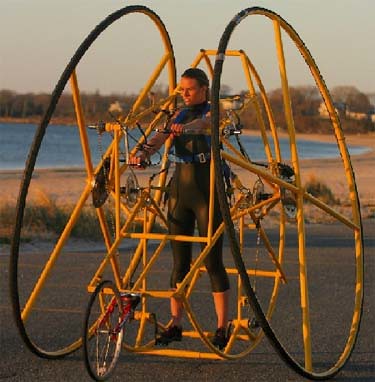
What is it, you ask? It’s a hyperbike — and NASA has put up a little cash to see where it goes (pun intended):
The Hyperbike is a working prototype created by inventor Curtis DeForest for a human-powered vehicle that will be faster than a traditional bicycle and much safer…
In creating the HyperBike, DeForest tried to remedy the flaws of the standard bicycle. For one thing, it has no seat; the rider stands upright. Also, the arms are used for additional power. DeForest describes pedaling the HyperBike as "swimming on dry land." Motor vehicle speeds of at least fifty miles per hour are easily attained….
One of the most interesting differences lies in the greater stability of the HyperBike. A conventional bicycle has the center of gravity higher than the spinning axis of the wheels. The HyperBike positions the rider in such a way as to put the center of gravity below the wheel axis.
Apparently, it is the stability and balance of weight relative to spinning forces that has NASA interested. These factors would make the Hyperbike a good choice for low gravity environments. The NASA-funded Space Alliance Technology Outreach Program has invested some capital in the development of the next model.
Now, I’ll admit to a tendency to get overly excited about these things — don’t even ask me about the Segway — but don’t you think this is pretty cool?
Talk about a Payload…
Tuesday, January 16th, 2007The Stanford Daily last week reported on a joint venture between NASA and Stanford University that would putting E. coli into space.
The project, which has been dubbed GeneSat-1, has involved the launching of a new non-harmful strain of E. coli bacteria into orbit in an attempt to observe the impact that zero gravity and space radiation have on the DNA of living organisms. By studying the data that is being transmitted to Earth from the shoebox-sized project satellite, the GeneSat-1 team believes that the mission could offer insight into the health risks of prolonged manned space missions. Spearheading the GeneSat-1 mission is a host of Stanford-affiliated technologists and NASA researchers.
I wonder if this is the first time blasting the bacteria commonly found in excrement into space might actually help humanity? I don’t know, but the mission appears to have been a part of the payload in the first launch from the Mid-Atlantic Regional Spaceport. Talking about some history making bacteria … hey, at least its not in my Spinach. 🙂
