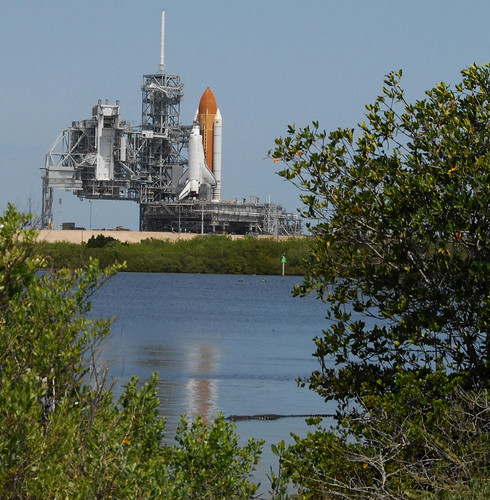
NASA’s space shuttle is on schedule to launch at 7:38 p.m. EDT (23:38 GMT) tonight, 8 June 2007. NASA’s Launch Blog will begin coverage at 1:30 p.m. (17:30 GMT). Read more about the countdown here. Take a close look at the photo above and you’ll see an alligator in the foreground.
Live HDTV coverage begins at 6:00 p.m. (22:00 GMT) on HDNet, and naturally NASA TV:
NASA Television is carried on an MPEG-2 digital signal accessed via satellite AMC-6, at 72 degrees west longitude, transponder 17C, 4040 MHz, vertical polarization. A Digital Video Broadcast (DVB) – compliant Integrated Receiver Decoder (IRD) with modulation of QPSK/DBV, data rate of 36.86 and FEC 3/4 is needed for reception. NASA TV Multichannel Broadcast includes: Public Services Channel (Channel 101); the Education Channel (Channel 102) and the Media Services Channel (Channel 103).
"A union representing about 570 United Space Alliance space shuttle program workers at Kennedy Space Center is recommending that the workers vote today to authorize a strike," Florida Today reports:
The bargaining team for the International Association of Machinists and Aerospace Workers Local 2061 believes that the company’s latest contract offer is "substandard," in relation to contracts at other aerospace companies, according to Lynn Beattie, a member of the bargaining team and former Local 2061 president.
He said the company’s proposals related to health care and retirement benefits are among the provisions the union doesn’t like.
The company and union were negotiating into the evening Friday before talks ended. Beattie said the union would present members with the company’s latest offer this morning.
If Local 2061 members turn down the contract, both sides still have a chance to resolve the situation during a five-day "cooling-off "period, Beattie said. If that is not successful, the workers could go out on strike as early as the end of next week, he said.
The IAM website urges its visitors to "keep the pressure on." Negotiations opened on May 21st, and have focused on job security and retirement concerns "in the wake of plans by NASA to shift from the current Space Shuttle program to next generation Ares/Orion systems." The United Space Alliance is a joint venture of The Boeing Company and Lockheed Martin, and is contracted as NASA’s main provider of services for the space shuttle program through 2010.
A strike, if voted upon, would not have an impact on the shuttle Atlantis launch scheduled for this Friday, because the Local 2061 workers’ jobs are not directly related to launches, according to a USA spokesperson.
Dark matter makes up more than 90% of the universe, yet because it neither emits nor reflects electromagnetic radiation, it cannot be observed directly.
Yet a group of astronomers in Baltimore have used the Hubble Space Telescope "to map the dark matter billowing out from the long-ago collision of two galaxy clusters."
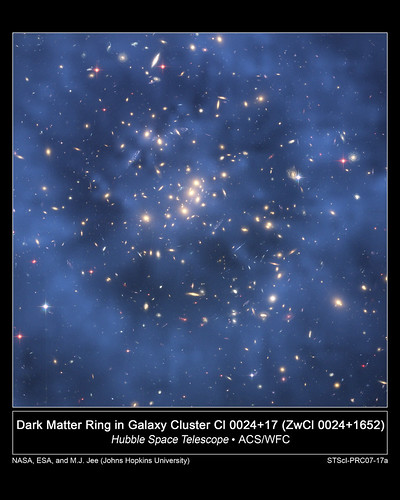
The photo released by NASA is quite extraordinary:
They’re calling it the strongest evidence yet of the existence of dark matter, and the first observation to separate it from its associated stars, galaxies and glowing gas.
"What we found is a very peculiar structure – a ring-like structure that surrounds the core of the cluster," said Johns Hopkins University research scientist M. James Jee, lead author on the study that will appear in the June 1 issue of The Astrophysical Journal.
It’s not exactly a ring of dark matter, he said. Rather, it’s a map of where the densest regions of dark matter must be, based on measurements of how that mass and gravity are bending the light streaming by from galaxies far in the background….
Jee likened the ring (in three dimensions actually a flattened spherical shell) to a jam-up of dark matter particles hurled outward from the collision, like commuters headed out of town, backing up behind slowing traffic ahead.
The Sun article notes that there is skepticism among some astronomers, who would like to see the evidence captured from a second source to rule out "peculiarities" in Hubble’s camera. Perhaps the image above is simply the astronomical equivalent of refracted light on film appearing as a "ghost" in your family photographs. Nonetheless, the evidence for dark matter is there, whether we’ve observed it yet or not.
(Also be sure to click here for a related video simulation of two galaxy clusters colliding.)
Watch this Hubblecast to better understand the significance of this finding.
No, not the Governor of New York, although that Spitzer did recently nominate a new Executive Director of the New York State Foundation for Science, Technology and Innovation.
Rather, we’re talking about the first map of an extrasolar planet, HD 189733b, a "hot Jupiter" planet — and the hottest planet yet observed in the universe — which is located approximately 60 light-years from Earth.
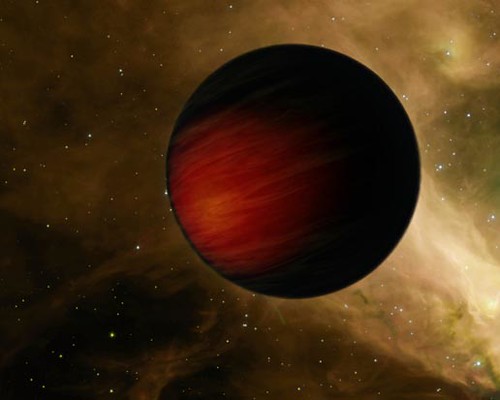
The planet is so hot that astronomers believe it’s absorbing almost all of the heat from its star, and reflecting almost no light and thus making its appearance black, as this artist’s rendition of the planet illustrates:
(Live animations of the picture above can be found here.)
NASA explains the mapping project and the resulting discoveries:
Roughly 50 of the more than 200 known planets outside our solar system, called exoplanets, are hot Jupiters. Visible-light telescopes can detect these strange worlds and determine certain characteristics, such as their sizes and orbits, but not much is known about their atmospheres or what they look like.
Since 2005, Spitzer has been revolutionizing the study of exoplanets’ atmospheres by examining their infrared light, or heat. In one of the new studies, Spitzer set its infrared eyes on HD 189733b, located 60 light-years away in the constellation Vulpecula. HD 189733b is the closest known transiting planet, which means that it crosses in front and behind its star when viewed from Earth. It races around its star every 2.2 days.
Spitzer measured the infrared light coming from the planet as it circled around its star, revealing its different faces. These infrared measurements, comprising about a quarter of a million data points, were then assembled into pole-to-pole strips, and, ultimately, used to map the temperature of the entire surface of the cloudy, giant planet.
The observations reveal that temperatures on this balmy world are fairly even, ranging from 650 degrees Celsius (1,200 Fahrenheit) on the dark side to 930 degrees Celsius (1,700 Fahrenheit) on the sunlit side. HD 189733b, and all other hot Jupiters, are believed to be tidally locked like our moon, so one side of the planet always faces the star. Since the planet’s overall temperature variation is mild, scientists believe winds must be spreading the heat from its permanently sunlit side around to its dark side. Such winds might rage across the surface at up to 9600 kilometers per hour (6,000 miles per hour). The jet streams on Earth travel at 322 kilometers per hour (200 miles per hour).
"These hot Jupiter exoplanets are blasted by 20,000 times more energy per second than Jupiter," said co-author David Charbonneau, also of the Harvard-Smithsonian Center for Astrophysics. "Now we can see how these planets deal with all that energy."
As Wired points out, Spitzer’s technology could be used to map Earth-like planets — like the recently-discovered Gliese 581c, which we wrote about here.
For more on the Spitzer Space telescope, check out this great video found in the motherlode of online video, aka YouTube:
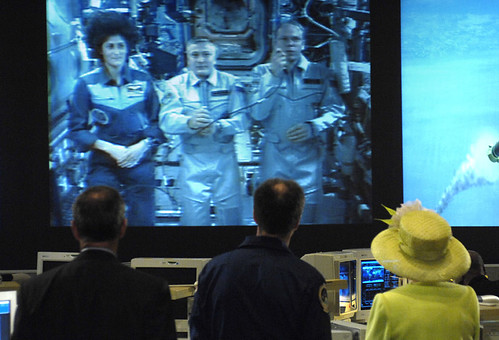
This visit also gives us a window on the future – both the future of the United States and the future cooperation between our countries. I particularly look forward in the next two days to seeing at first hand something of how the cutting edge of science and technology can take us to the next phases of discovery and exploration in human endeavour.
During the next two years, AIM scientists will methodically address each of six fundamental objectives that will provide critical information needed to understand cloud formation and behavior.
"This mission has many firsts, including that Hampton University is the first historically black college and university to have the principle investigator and total mission responsibility for a NASA satellite mission," said Program Executive Victoria Elsbernd, NASA Headquarters, Washington.
NASA’s Kennedy Space Center, Fla., is responsible for launch vehicle/spacecraft integration and launch countdown management. NASA’s Goddard Space Flight Center, Greenbelt, Md., is responsible for the overall AIM mission management in collaboration with Hampton University, the University of Colorado, Boulder, and Virginia Polytechnic Institute and State University, Blacksburg. Orbital Sciences Corporation, Dulles, Va., is responsible for providing the Pegasus XL launch service to NASA.
As seen in the photo above, NASA is releasing the first 3-D photos taken by the STEREO project at a press conference taking place in the next few minutes. According to the NASA press release, these photos represent a significant advance in astronomy, allowing those who study the heavens an opportunity to finally really see what they’re observing.
"In the solar atmosphere, there are no clues to help us judge distance. Everything appears flat in the 2-D plane of the sky. Having a stereo perspective just makes it so much easier," said Dr. Russell Howard of the Naval Research Laboratory, Washington, the Principal Investigator for the SECCHI (Sun Earth Connection Coronal and Heliospheric Investigation) suite of telescopes on the spacecraft.
‘With STEREO’s 3-D imagery, we’ll be able to discern where matter and energy flows in the solar atmosphere much more precisely than with the 2-D views available before. This will really help us understand the complex physics going on,’ said Howard."
Oh, and the knowledge gained by the observation will do more than look pretty, helping scientists better gauge changes in space weather patterns and forecasts by helping them better understand Coronal Mass Ejections (CMEs).
"CMEs are eruptions of electrically charged gas, called plasma, from the sun’s atmosphere. A CME cloud can contain billions of tons of plasma and move at a million miles per hour.
The CME cloud is laced with magnetic fields, and CMEs directed toward Earth smash into our planet’s magnetic field. If the CME magnetic fields have the proper orientation, they dump energy and particles into Earth’s magnetic field, causing magnetic storms that can overload power line equipment and radiation storms that disrupt satellites.
Satellite and utility operators can take precautions to minimize CME damage, but they need an accurate forecast of when the CME will arrive. To do this, forecasters need to know the location of the front of the CME cloud. STEREO will allow scientists to accurately locate the CME cloud front. ‘Knowing where the front of the CME cloud is will improve estimates of the arrival time from within a day or so to just a few hours,’ said Howard. ‘STEREO also will help forecasters estimate how severe the resulting magnetic storm will be.’"
Those interested in seeing more will definitely want to check out the STEREO mission page following the press conference (11:00am EDT) when additional photos will be released.
So what do you call a space agency with no institute for advanced research? Wait, you can still call it a space agency?
While that’s not much of joke, it reflects the increasingly grim reality at NASA if the recent reports in the New Scientist and WIRED are believed to be true that suggest the NASA Institute for Advanced Concept (NIAC) is being closed due budget constraints. What’s the ironic source of the constraint’s that might put an end to NASA most forward thinking research institution? Why building the next generation space craft set to replace the shuttle after its forced retirement in 2010.
For those who haven’t seen the manydifferent stories we’ve done on all the various projects the NIAC has undertaken since its 1998 founding, NAIC has a far out mission that aims to prepare NASA for humanity’s future in space, from their website:
"NIAC seeks proposals for revolutionary aeronautics and space concepts that could dramatically impact how NASA develops and conducts its missions. It provides a highly visible, recognizable, and high-level entry point for outside thinkers and researchers. NIAC encourages proposers to think decades into the future in pursuit of concepts that will "leapfrog" the evolution of current aerospace systems. While NIAC seeks advance concept proposals that stretch the imagination, these concepts should be based on sound scientific principles and attainable within a 10 to 40-year time frame."
"This is just plain stupid. Let me repeat this for clarity’s sake, Mike [Griffin, NASA Administrator & "head honcho"], (whoever made it) this is A STUPID DECISION. Advanced spacesuits that will open the surface of the moon – and then Mars- to meaningful and productive human exploration, tethers and other innovative and upmass-saving technologies, and other in-space technologies.
Where are you going to get all of the things you need to put on those Ares rockets so as to allow their crews to carry out their missions, Mike? Or do you "just need a good map"? Explorers without the right tools die – or turn around – and head back home. Wrong answer, Mike."
An aging satellite that has been in operation for seven years but was expected to last for only five is putting America’s hurricane forecasting ability at risk, according to a story from the Associated Press.
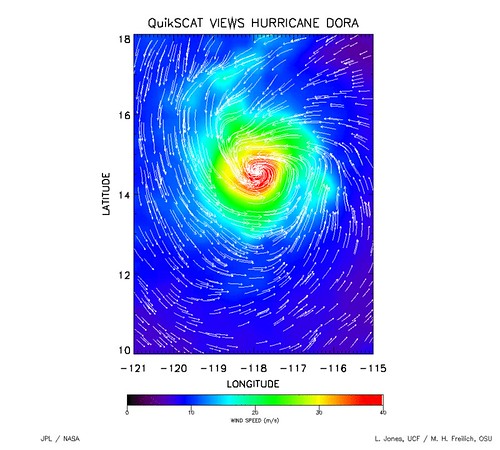
The QuickSCAT satellite "conducts daily surveys of 90 percent of the ice-free oceans, using a so-called radar scatterometer to measure surface wind speed and direction."
The resulting images are not only visually compelling — they provide scientists with fresh information about our planet’s weather patterns.
(For example, this set of images helped scientists understand that the Santa Ana winds that dry out coastal and interior regions of California and help fan the flames of wildfires produce a previously unknown benefit to the region’s fisheries.)
But the cause celebre of QuickSCAT are images like the one above, showing the wind speeds of Hurricane Dora back in 1999.
But scientists may have to attempt hurricane forecasts without the aid of QuickSCAT, according to the AP report:
Certain hurricane forecasts could be up to 16 percent less accurate if a key weather satellite that is already beyond its expected lifespan fails, the National Hurricane Center’s new director said Friday in calling for hundreds of millions of dollars in new funding for expanded research and predictions….
One of Proenza’s immediate concerns is the so-called "QuikScat" weather satellite, which lets forecasters measure basics such as wind speed. Replacing it would take at least four years even if the estimated $400 million cost were available immediately, he said.
It’s in its seventh year of operation and was expected to last five, Proenza said, and it’s only a matter of time until it fails.
Without the satellite providing key data, Proenza said, two- and three-day forecasts of a storm’s path would be affected. The two-day forecast could be 10 percent worse, while the three-day one could be affected up to 16 percent, Proenza said.
That would mean longer stretches of coastline would have to be placed under warnings, and more people than necessary would have to evacuate, he said.
We’ll keep you updated (as we always do) on efforts to replace QuickSCAT and other observation satellites that help bring people the accurate forecasts (we’re not joking here!) that they’ve come to expect.
The effort to improve space weather capabilities took a major step forward last week with the transmission of never-before-seen images of a solar eruption traveling the 93 million miles from the sun to Earth.
Sent back by the twin satellites of NASA’s newly launched Solar Terrestrial Relations Observatory (STEREO), the video is part of an ambitious new effort to learn more about massive electromagnetic storms on the sun, and the dynamics and characteristics of their eruptions. The sun is a huge furnace of nuclear fusion, in constant turmoil with flares, eruptions, convections and the release of lower-energy solar winds.
The "fronts" produced by coronal mass ejections, as the biggest eruptions are called, are the prime movers of space weather in Earth’s neighborhood, and understanding them better is essential to space weather forecasting.
"With STEREO, we can track the front from the sun all the way to Earth and forecast its arrival within a couple hours," said Russell Howard, principal investigator for STEREO’s most cutting-edge instrument, which will allow researchers to observe the movements of solar eruptions in three dimensions. "The new views from STEREO are like having a curtain lift from our eyes — they are extraordinarily instructive."
They are also pretty amazing, as this video animation taken from STEREO images shows.
The Washington Post continues:
STEREO cost NASA and its European partners about $600 million to build and is expected to operate for at least two years. It has already detected somewhat surprising characteristics of the solar eruptions. Researchers have, for instance, located "hot spots" within a solar eruption as it speeds from the sun, and they have seen loops and arcs formed from the hot plasma. They have also begun to measure the velocity of the eruptions, which gradually slow as they collide with other solar matter moving far more slowly in the solar winds.
Like most researchers, STEREO team members say they are looking for solar surprises as much as confirmation of existing hypotheses. The detailed study of space weather is in its infancy, they said, and the opportunity for discovery is vast.
We’ll keep you updated on STEREO’s discoveries as they are reported; in the interem, be sure to check out the STEREO mission homepage for the latest developments.



 To the left: An image of a February 25 eclipse taken from NASA’s STEREO-B satellite.