Author Archive

License (Plate) to Track

Thursday, July 27th, 2006

She may not be real, but I’ve got some advice for that girl Emily. If really want to keep track of a straying spouse, track his license plate.

PlateFinder

Jealous lovers may soon have an alternative to sniffing for perfume to catch a cheating mate: Just follow their license plate.

In recent years, police around the country have started to use powerful infrared cameras to read plates and catch carjackers and ticket scofflaws. But the technology will soon migrate into the private sector, and morph into a tool for tracking individual motorists’ movements, says former policeman Andy Bucholz, who’s on the board of Virginia-based G2 Tactics, a manufacturer of the technology.

Bucholz, who designed some of the first mobile license plate reading, or LPR, equipment, gave a presentation at the 2006 National Institute of Justice conference here last week laying out a vision of the future in which LPR does everything from helping insurance companies find missing cars to letting retail chains chart customer migrations. It could also let a nosy citizen with enough cash find out if the mayor is having an affair, he says.

Or it could let a suspicious spouse find out if the other half is stepping out.

Just one more step in the tracking of everything and everyone. But wouldn’t this be easier with GPS? After all, it works for lost dogs, gang members.

Emily could just get her husband a new phone, say from Sprint or Verizon, but that might make him suspicious. (Then again, a billboard is pretty big tip-off.) But chances are he already has a mobile phone and, as I noted earlier, anyone with a mobile phone can be located and tracked. Next time she wants to hit the joint banking account to send a message to Steven, Emily might consider signing on with AccuTracking, World-Tracker, or U-Locate. The more subtle and probably also cheaper than putting up billboards across the country.


Robots March on Microsoft, Linux

Tuesday, July 25th, 2006

A while ago, I blogged about Microsoft’s foray into Robotics with its Robotics Studio software. Well the Microsoft robotics march continues, but this time the robots are marching on Microsoft due to a bit of synergy with Lego’s own robotics project. Thanks to the toy company, you can build your own robot.

Lego Robot Swiffer

Lego Mindstorms NXT includes LabView software from National Instruments, which lets robot makers program their machines by dragging and dropping icons on the screen instead of writing code. The software works with both Windows XP and recent versions of Mac OS X. Bluetooth wireless signals are supported, so finished robots can be controlled with compatible mobile phones.

The Lego Mindstorms NXT kit, which sells for about $250 and is aimed at children age 10 and older, will arrive in stores early [this] month; it can also be ordered at www.mindstorms.com. The Mindstorms kit includes 519 Lego Technic building blocks; sound, light and touch sensors; a 32-bit microprocessor called the NXT Intelligent Brick, which serves as the robot’s brain; and several motors. Batteries, however, are not included: six AA cells are required.

Lego, it turns out, was a major inspiration in getting Microsoft into the robotics business.

Even a software giant, it seems, has a soft spot for Legos.

"Lego was one of the motivating factors that got this started in the first place," said Tandy Trower, general manager of Microsoft’s robotics initiative, which launched in June. He explained how Lego had told Microsoft about its Mindstorms NXT plans several years ago, even as Trower was beginning to formulate what his group would be like.

Now Microsoft is hoping its robotics suite, which can help people design anything from simple robots to industrial projects, will be seen as an innovative step to getting more people interested in robots. He likens the state of robotics today to that of the early days of PCs.

The synergy with Lego might be great, but here’s a heads-up to Microsoft: Lego’s robots may be marching in your direction, but it looks like some robot enthusiasts are turning to Linux.

Chromet

To spur more development of robots at the hobbyist level, Japan’s National Institute of Advanced Industrial Science and Technology (AIST) is promoting a humanoid creature named HRP-2m Choromet. One problem with current robots, AIST says, is that they tend to be little more than remote-controlled devices. Another is that getting beyond that evolutionary stage tends to take a lot of cash.

Choromet, which bears a striking resemblance to the Transformers character Optimus Prime, comes with programmable software that runs on Linux. It was developed by General Robotix, one of two start-ups working under AIST together with Pirkus Robotix and Dai Nippon Technical Research Institute. The controller, which is driven in real time by AIST’s ArtLinux, was developed by Moving Eye, the other start-up in the group

I dunno. Sure, Choromet looks cool. But I’m thinking that Lego robot with the Swiffer attachment (pictured above) would be a lot handier around the house.


Heatwave, As Seen From Space

Tuesday, July 25th, 2006

Hot enough for ya? You don’t have to read the news to know there’s a heatwave going on, even though it’s heating up Europe to the point that some people think houses may collapse (due to subsidence if heavy rain causes the bone-dry soil to expand and move buildings as it does so). And things have gotten so hot in the U.S. that blackouts and power outages are happening in California, Missouri, and New York.

All you really have to do is step outside. But if you want the big picture, you can check out Envisat’s satellite pictures of Europe which, according to the BBC, show dramatic increases in land and sea temperatures in the UK.

ENVISAT

The images were generated from data gathered by the European Space Agency’s Envisat and Nasa’s Aura satellites.

John Remedios, head of Earth Observation Science at the University of Leicester, said: "The latest satellite data shows a perspective of the environment in which we live that can only be obtained from space.

"The images show temperature increases and increased pollution for every region in the UK."

Envisat, an advanced polar-orbiting Earth observation satellite, was launched in March 2002 by the European Space Agency and provides measurements of the atmosphere, ocean, land, and ice.


Happy Anniversaries

Thursday, July 20th, 2006

Pop quiz. Where were you 37 years ago today? Where were you 30 years ago today?

Moon Walk

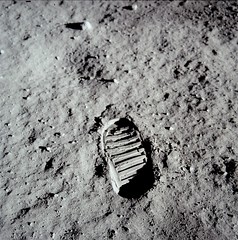
In the first case, I’m not sure where I was, but I was probably learning how to sit up. Meanwhile Neil Armstrong and Buzz Aldrin were becoming the first humans to walk on the moon.

Viking I

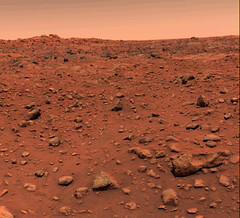
Seven years later, I was walking, talking, and probably getting underfoot around the house when Viking I became the first spacecraft to land safely on another planet.

Via Respectful Insolence and MetaFilter.

Might As Well (Not) Jump

Thursday, July 20th, 2006

Remember that urban legend about how you can save your life in a plummeting elevator by jumping just before impact? According to the experts, it doesn’t work. But that doesn’t seem to be stopping some people from trying a similar trick to stop global warming today, on World Jump Day.

Apparently the jump was scheduled for 11:39:13 Greenwich Mean Time, so if you’re reading this you’ve already missed it, which is fine because apparently it’s a hoax.

But just for laughs, here’s how it’s supposed to work.

World Jump Day

Hans Peter Niesward, from the Department of Gravitationsphysik at the ISA in Munich, says we can stop global warming in one fell swoop — or, more accurately, in one big jump.

The slightly disheveled professor states his case on WorldJumpDay.org, an Internet site created to recruit 600,000,000 people to jump simultaneously on July 20 at 11:39:13 GMT in an effort to shift Earth’s position.

Niesward claims that on this day "Earth occupies one of the most fragile positions in its orbits for the last 100 years." According to the site, the shift in orbit will "stop global warming, extend daytime hours and create a more homogeneous climate."

And according to Phil, here’s why it wouldn’t work.

First, there’s the problem with mass. 600 million people sounds like a lot, but the Earth is big. Really, really big. Let’s say each person weighs 100 kilograms to make it easy (that’s 220 pounds, so we’re already being generous). 600 million people times 100 kg = 60 billion kilograms. That’s a lot of meat! But the Earth masses 6 x 1024 kg, or 6,000,000,000,000,000,000,000,000 kg. In other words, the Earth weighs (well, masses) 100 trillion times the total mass of all those people!

…The second problem is one of placement. Even if 600 million people could move the Earth, they’re located all over the world. The Earth being a ball, that means that people in, say, northern Spain will be perfectly canceled out by people in New Zealand. You’d need to get all 600 million people in one place on Earth to do this. Not only that, you’d have to find the right place so that when the Earth moved, it went in the right direction. Global warming won’t be stopped if you accidentally move the Earth closer to the Sun. That also means timing the jump perfectly, since the Earth rotates.

…Finally, there is another basic reason this won’t work, even if everyone on the Earth weighed 100 trillion times as much. The problem is that we’re a closed system. If we get everyone to jump up, they’ll fall back down. So even if we were able to push the Earth in one direction by jumping, when we come back down we’ll move the Earth back to where it was!

Are there more reasons it wouldn’t work? Anyway, it sounds like fun, and if my timing hadn’t been off I might have joined in. The physics of it all are a bit beyond me, and I’m willing to bet that’s true of most people. So, if I’d jumped how many people would have been jumping with me?

Return of the Flying Robots

Wednesday, July 19th, 2006

Remember those flying robots I mentioned earlier, and how I said they Europe has them already? Well, I didn’t know how right I actually was. Turns out Britain is shelling out big bucks to get a fleet of flying robots off the ground.

The British government plans to spend 16 million pounds–about $28 million–on the development of robot aircraft that could be used for police and fire surveillance.

The government said that development of unstaffed craft could "revolutionize" police and fire surveillance, as well as powerline and pipeline inspections–all of which currently rely on human-flown aircraft.

The investment will support a $57.9 million project called Autonomous Systems Technology Related Airborne Evaluation and Assessment, or Astraea.

No word on whether these flying robots — unmanned aerial vehicles — will be outfitted with tentacles or not.

GeneBox on Board

Wednesday, July 19th, 2006

It turns out that private spacecraft launch I blogged last week wasn’t exclusively a private entrepreneurial affair. NASA was along for the ride in Bigelow’s balloon, in the form of an experimental micro-lab the agency calls a GeneBox.

Bigelow

The space agency sent up a so-called GeneBox, a micro-lab, with Bigelow Aerospace’s Genesis I last week, piggybaggying a ride on the commercial spaceflight test.

The Genebox is about the size of a shoebox and is attached to the internal structure of Bigelow’s 14-foot inflatable spacecraft, which the company launched from Russia as a demonstration of an affordable human space complex it hopes to launch by 2015. NASA’s GeneBox contains a miniature laboratory of sensors and optical systems that can detect proteins and specific genetic activity. In two weeks, the Bigelow ground control station in Las Vegas, Nev., will activate the GeneBox, and once its tests are complete, data from GeneBox will be relayed to the ground for analysis.

According to NASA, GeneBox will analyze how the near weightlessness of space affects genes in microscopic cells and other small life forms. "During this mission, we are verifying this new, small spacecraft’s systems and our procedures," John Hines, the GeneBox project manager at NASA Ames Research Center in California’s Silicon Valley, said in a statement.

More on XM v. RIAA

Wednesday, July 19th, 2006

A while back I posted about the RIAA lawsuit against XM Radio, claiming $150,000 in damages for each song that XM’s Inno device downloads from its satellite service. Well, now it looks like XM is stepping up and asking a federal judge to toss the case out of court.

XM Radio

XM Satellite Radio asked a U.S. federal judge Monday to throw out a copyright lawsuit by the recording industry over the company’s new iPod-like device that can store up to 50 hours of music.

XM Satellite said the 1992 Home Recording Audio act protects it from being sued over its $400 (U.S.) handheld "Inno" device. The law bans some copyright claims against equipment makers and consumers who make digital music recordings for private use.

… XM Satellite has compared its new device to a high-tech videocassette recorder, which consumers can legally use to record programs for their personal use. It also noted that songs stored on the device from its broadcasts can’t be copied and can only be played for as long as a customer subscribes to its service.

Sounds familiar. I’m probably giving away my age by saying this, but when I was a kid I spent lots of time listening to the radio, and when a favorite song of mine came on I’d hit the "Record" button on the cassette player, and record songs until I had a tape full of my favorites (though minus the beginning of the song in some cases). XM’s player sounds a lot like that. And, as I noted before, if XM subscribers want to have their favorite songs on other devices they can download them from pay services like Napster or iTunes, thus effectively paying for the songs twice — once as XM subscribers and again to download from a pay service.

Of course XM may be seeking to get the case behind them, since they’re about to launch Oprah’s radio show in August, but also because the competition is catching up with them. The Globe & Mail article notes that XM has balked at notion of having to buy expensive distribution licenses from the recording industry, but that Sirius has agreed to pay for those licenses to cover its own similar players. Meanwhile the buzz in the business world is that Sirius is closing in on XM’s subscriber numbers and that XM CEO Hugh Panero may have to work to get the buzz back in XM’s favor.

WaPo columnist Steve Pearlstein has more on the case of XM v. RIAA, and answered questions this morning in an online chat.

Bastille Day Shock

Friday, July 14th, 2006

Today is Bastille Day, commemorating the flare-up of the French Revolution in 1789. In that sense it’s kind of like our 4th of July, except that where we supply our own fireworks le soliel got supplied them for Bastille Day in 2000. It was called the Bastille Day Shock.

A transient flow system containing several streams and shocks associated with the Bastille Day 2000 solar event was observed by the WIND and ACE spacecraft at 1 AU. Voyager 2 (V2) at 63 AU observed this flow system after it moved through the interplanetary medium and into the distant heliosphere, where the interstellar pickup protons strongly influence the MHD structures and flow dynamics.

Um. Yeah. Just what all that means, I don’t know. But I do know that it looked really cool, thanks to the pictures and videos accompanying this somewhat simpler explanation of what happened when the sun celebrated Bastille Day.

Bastille Day Shock

On July 14, 2000, an enormous x-class flare was observed near the center of the solar disk of the Sun (a-b).

An x-class flare is the most intense flare recorded and, like smaller flares, is thought to be the result of reconnection at the base of the solar corona.

The Bastille Day flare may have been produced by a larger, more violent and active version of the reconnection event being shown in this movie (c).

More on Bigelow, Genesis

Thursday, July 13th, 2006

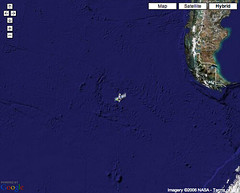
Via Space Pragmatism, here are not one but two interviews with Robert Bigelow, the man responsible for yesterday’s launch of an experimental inflatable spacecraft. There’s also a pretty neat Google Maps site for tracking Genesis in orbit.

Tracking Genesis