Author Archive

Parking Robot Gone Wrong

Tuesday, August 8th, 2006

Every think it might be cool to have a robots take over some of the mundane tasks of life, like parking your car? Sounds good, at least in theory, right? And maybe it is when it works. But if the robot’s software has a glitch, or the owner neglects to renew the software license? Well, then it’s not pretty.

Car Parking RobotThe robot that parks cars at the Garden Street Garage in Hoboken, New Jersey, trapped hundreds of its wards last week for several days. But it wasn’t the technology car owners had to curse, it was the terms of a software license.

The garage is owned by the city; the software, by Robotic Parking of Clearwater, Florida.

In the course of a contract dispute, the city of Hoboken had police escort the Robotic employees from the premises just a few days before the contract between both parties was set to expire. What the city didn’t understand or perhaps concern itself with, is that they sent the company packing with its manuals and the intellectual property rights to the software that made the giant robotic parking structure work.

The Hoboken garage is one of a handful of fully automated parking structures that make more efficient use of space by eliminating ramps and driving lanes, lifting and sliding automobiles into slots and shuffling them as needed. If the robot shuts down, there is no practical way to manually remove parked vehicles.

It took a few days to iron everything while car owners pined for the imprisoned vehicles, but the city and the software company came to an agreement for a three year software license. (If I were a car owner who parked in that garage, I’d mark the date on my calendar.) It’s an amusing story if you didn’t have a car in that garage, but it underscores that with new technology comes issues that earlier adopters — both cities and citizens — may not have fully considered in their rush to embrace the new tech. Sometimes for every old problem solved a new one is created.
Google Watching You Watch TV?

Monday, August 7th, 2006

Sebadoh posted on Friday about Google getting into the satellite radio business. Well, it looks like Google is also making forays into television. Not producing, mind you, but monitoring what you watch and producing related internet content.

In a research paper presented last week at interactive television conference Euro ITV in Athens, Greece, Google researchers Michele Covell and Shumeet Baluja propose using ambient-audio identification technology to capture TV sound with a laptop PC to identify the show that is the source of the sound and to use that information to immediately return personalized Internet content to the PC.

"We showed how to sample the ambient sound emitted from a TV and automatically determine what is being watched from a small signature of the sound—all with complete privacy and minuscule effort," Covell and Baluja write on the Google Research Blog. "The system could keep up with users while they channel surf, presenting them with a real-time forum about a live political debate one minute and an ad-hoc chat room for a sporting event in the next."

… According to Boralv, the system wouldn’t be that intrusive. She writes, "If you were watching the news and wanted to delve deeper, this type of system could allow you to do that easily by automatically collecting related material and Web links for you. The beauty of the system that Michele and Shumeet describe is that it wouldn’t be a distraction. If you don’t want it you can ignore it and the PC browser will quietly update pages without bothering anyone—no input required and no audible output to form a distraction."

Those appalled by the prospect of Google tapping your television take heart: The proposal suggests user privacy would be respected. "[O]ur approach will not ‘overhear’ conversations," the paper says. "Furthermore, no one receiving (or intercepting) these statistics is able to eavesdrop, on such conversations, since the original audio does not leave the viewer’s computer." Perhaps there’s a lesson here for the National Security Agency.

Creepy? Or just the next step in increased synergy between new media and old? I can’t decide, but the Interactive TV Today blog describes in a bit more detail how Google might "overhear" what you’re watching.

[The system] would use a PC microphone to sample the ambient sound emitted by a television set and automatically determine what is being watched on that set from a small signature of that sound. The system would then use the data thus gathered to automatically present the viewer–in real time on his or her Web browser–with contextually relevant information, and with ad-hoc services that would enable social interaction around programming: thus, if the viewer were watching a sporting event, the system might present him or her with an ad-hoc fan forum; and if the viewer were to switch to a movie, it might present him or her with maps of the locales featured in the movie or with a bio of the actor currently appearing on the TV screen.

The system is composed of three distinct components: "a client-side interface, an audio-database server (with mass-media audio statistics), and a social-application Web server," the three scientists write in the paper’s introduction. "The client-side interface samples and irreversibly compresses the viewer’s ambient audio to summary statistics. [Note: the authors note that this irreversible mapping would serve to protect the viewer’s privacy.] These statistics are streamed from the viewer’s personal computer to the audio-database server for identification of the background audio (e.g., ‘Seinfeld’ episode 6101, minute 3:03). The audio database transmits this information to the social-application server, which provides personalized and interactive content back to the viewer."

One more question. How does this relate to Google partnering with Viacom to test sharing ad revenues from web videos? Is there a possible tie-in here? Maybe Google monitors what you’re watching and turns up related web videos? Clips from other shows you might be interested in, from Google’s ad partners?

Blast from the Past: Hotbird 8

Monday, August 7th, 2006

We’ve got another rocket launch for you. This time it’s one from the more recent past. The HOT BIRD 8 broadcast satellite was place into orbit on Friday via a Proton Breeze M launch vehicle, and we’ve got the video.

We’ve also got a blog post from the HOT BIRD 8 team describing the launch.

We are thrilled to have a successful return to flight for Proton M Breeze M. After a long and sleepless night, 9 hours, 11 minutes, and 20 seconds after lift-off, spacecraft separation was confirmed and the HOT BIRD 8 SC was acquired by the Eutelsat ground stations. The Eutelsat team started the process of opening the solar arrays and beginning health checks of the SC, before flying her to her final destination. After having been up all night, we headed back to the hotels to catch a quick nap and freshen up before the post-launch festivities.

See the press release for more information.

City Wi-Fi, Green Wi-Fi

Wednesday, August 2nd, 2006

It’s been a long time since I blogged about my enthusiasm for municipal wi-fi, but news from Boston brought the subject back to mind again.

Wi-FiBoston’s plan to create a citywide wireless Internet network entered a new phase yesterday as Mayor Thomas M. Menino named former high-tech executive Pamela Reeve to lead the search for a non profit corporation to build the network.

Reeve, a member of the mayor’s Wireless Task Force and a former chief executive of software company Lightbridge Inc., also will talk to businesses, foundations, universities, and hospitals in an effort to raise between $16 million and $20 million for the project.

The money would be used to blanket city neighborhoods with fiber-optic cable and radio transmitters that would beam WiFi signals, enabling laptops, handheld computers, cell phones, and other portable devices to connect to the Internet at high speeds anywhere in the city.

As noted at GigaOm, this model is unlike any other in blending resources from government, business and non-profits. Can it work? Who knows, but if it does the next step might be to combine it with an idea like One Laptop Per Child movement, but with a domestic focus. Nigeria just ordered (and payed for) 1 million of the wireless-equipped laptops. It could happen in the U.S. too — wi-fi access and low-cost wireless laptops opening up new opportunities for a lot of kids.

And as long as cities are launching wi-fi networks, the might want to consider making them green too.

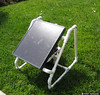
Green Wi-FiThe technical concept behind the Green Wi-Fi network is fairly simple. Each node in the network consists of a battery-powered router and a solar panel to charge the battery. The nodes are mounted on rooftops, and the network’s Wi-Fi signals are transferred over a grid using a wireless network standard known as 802.11b/g.

The first seed money has arrived, enough to produce and test prototype nodes. It came from the One Laptop Per Child initiative (OLPC), which aims to construct a $100 laptop to be distributed to children in developing countries. OLPC showed immediate interest in the Wi-Fi initiative, Pomerleau said.


We Got Your Rocket Scientsts Right Here

Wednesday, August 2nd, 2006

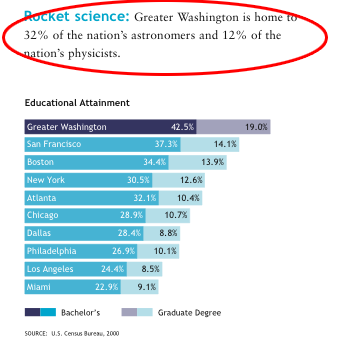
Here’s an interesting tidbit. Here in DC, I’m surrounded by rocket scientists. OK, not surrounded but it turns out the metro-DC area is home to a large percentage of the rocket scientist population. Higher than most cities, I bet.

The latest issue of The Washingtonian pulls some data from the Greater Washington Initiative’s latest regional report, which puts the percentage of rocket scientists in the area at 32% of the population. (12% of the nation’s physicists).

Rocket Scientists in DC

Impressive. But that’s only about a third of the country’s rocket scientists. Where are the rest of them? Where are most of them?


Blast from the Past: Titan IV

Tuesday, August 1st, 2006

Titan IV

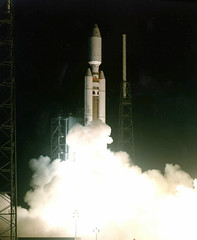
We reached into our video archives and pulled out two rocket launches to show you. Titan IV is the largest unmanned space booster used by the U.S. Air Force to carry payloads as big as the ones the space shuttle carries.

On September 8, 2003, Communications Concepts, Inc. broadcast the launch of the massive Titan IV as it blasted off the launch pad at Cape Canaveral Launch Complex 40. The day’s payload was a satellite for the National Reconnaissance Office. The model rocket was the Titan IV-B, the final model of the now retired Titan program, which was the largest, most powerful, heavy-lift expendable launch vehicle in the United States at the time. This mammoth rocket was as tall as a 20-story building and, with the solid rocket boosters and fuel, weighed about 940,000 kilograms (2 million pounds). In the video, you can see the sheer power of the Titan as the shot, captured from a remote camera less than 500 feet from the launch pad, fills with white just after liftoff.


The Missing Moonwalks

Monday, July 31st, 2006

A couple of weeks ago, I posted about the dual anniversaries of the Viking I landing on Mars and the first humans (Neil Armstrong and Buzz Aldrin) to walk on the moon. Well, NPR has video footage of Armstrong’s and Aldrin’s lunar jaunts. The only problem is that they’re pretty shoddy copies. So NPR is looking looking for the original footage.

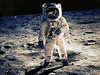
LandingAlmost everyone on the planet who had access to television watched the first moon landing, back on the night of July 20, 1969. What the TV viewers didn’t know is that they weren’t seeing the best images.

The astronauts actually beamed higher-quality footage back to Earth, but it was only seen by a small number of people at three tracking stations.

Those original images were recorded and put into storage — somewhere. Now, a small crew of retirees, space enthusiasts, and NASA employees are searching for a moon landing that the world has never seen.

The NPR piece goes on to describe how the images most Americans saw on their televisions sets back in 1969 were so degraded — compared to what the folks in Houston’s mission-control saw — and incompatible with television broadcasts that they had to be converted to the right format. Afterwards, the original footage was recorded onto 14-inch reels, which disappeared into the National Records Center in Maryland before NASA brought them to Goddard for "permanent retention." They haven’t been seen since.

The folks from the Apollo team would like very much to see the footage again. Actually, so would I. For the first time, of course.


A Closer Look At GeneBox

Monday, July 31st, 2006

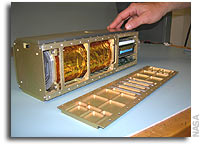
SpaceRef has a bit more about the NASA GeneBox I posted about last week, that’s on board Robert Bigelow’s Genesis I spacecraft. Including a tiny little photograph.

GeneBoxNamed "GeneBox", this small payload was developed by NASA Ames Research Center to test out new ways to perform in-flight genomic analysis of living systems. Indeed, much of what is being flown aboard this satellite is cutting edge biotech – the likes of which have yet to fly aboard the International Space Station. Future versions will be even more capable.

NASA developed the GeneBox payload and Bigelow Aerospace integrated and launched GeneBox – at no cost to NASA. ARC estimates that GeneBox cost approximately $1 million to fabricate, test, and prepare for flight. GeneBox is an adaptation of the "GeneSat" free flyer nanosatellite. NASA ARC expects GeneSat to cost approximately $6 million to develop.

GeneBox was funded entirely by NASA. This effort began with the (now disbanded) NASA Office of Biological and Physical Research (OBPR), then by the NASA Exploration Systems Mission Directorate (ESMD), and currently with NASA ARC internal R&D funds.

Of course, NASA’s collaboration with Bigelow is even more interesting in light of news that the agency is thinking about canning its space station research.


Your Mobile Phone & Your Money

Monday, July 31st, 2006

If you’re as absent minded as me, you’ve probably left home once or twice without your wallet, but with your mobile phone attached to your hip. Well, in the future forgetting your wallet may not matter so much as long as you have your mobile phone, at least where needing cash on hand is concerned. Your mobile phone may serve as your wallet.

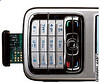
NFC ChipBy next year, you’ll be able to pay simply by swiping your cell phone a few inches from a cash register, with a new wireless standard called Near Field Communication.

An NFC chip in your phone will send your credit-card number — stored on your phone or on the chip — by way of short-distance radio waves.

An electronic reader at the checkout will decode the number and ring up your purchase. Unlike radio-frequency identification (RFID) and other existing contactless payment systems, NFC chips allow two-way information exchange by rolling an RF transmitter and reader into one five-millimeter package.

That means the chip can also take in data, such as a receipt zapped to it by a cash register or a bus schedule from a tag embedded in a bus-stop sign.

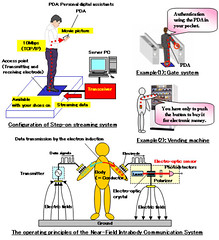
What’s Near Field Communications? Glad you asked. (And if you didn’t, I did.) This definition includes a handy chart.

Near Field Communications

But the NFC Forum has the easiest explanation I’ve found.

Near Field Communication (NFC) uses the same principle to link electronic devices. It enables the user to exchange all kinds of information, securely, simply by bringing two devices close together. Its short-range interaction over a few centimeters greatly simplifies the whole issue of identification, as there is less confusion when devices can only "hear" their immediate neighbors.

Evolving from a combination of contactless identification (RFID) and interconnection technologies, NFC technology bridges today’s connectivity gap. It enables the simple transfer of information — from phone numbers to electronic transactions — and allows people to interact with their environment without needing to navigate complicated menus or perform complex set-up procedures.

I wasn’t sure sure what makes that any different than Bluetooth or wi-fi, but apparently it’s a matter of range.

While Bluetooth and Wi-Fi have a range anywhere between 33 feet and 300 feet, NFC deals in inches — eight inches, to be precise. NFC "is designed for shorter distances and lighter content," says Karsten Ottenberg, General Manager of Philips Semiconductors’ Identification unit.

Great. There are only two drawbacks I can think of, and one of them has already been shot down. First, I thought I’d have to buy a new phone, but it turns out simple add-on chips will be available and that they’re pretty inexpensive to produce. That just leaves one problem. Would losing your phone become the same as losing your wallet?


Send Your Junk Into Space

Thursday, July 27th, 2006

This might be a good way of getting rid of excess junk that you have lying around: Send it to space. Earlier this month I posted about the launch of Robert Bigelow’s inflatable spacecraft, Genesis I. Well, via Space Pragmatism comes news of Bigelow’s next big plan. When Genesis II goes up, he’s gonna let you fly your stuff into space, and send you pictures too.

Whereas space was once the domain of only the privileged, Bigelow Aerospace is offering the public an exciting new opportunity to reach the final frontier. For the first time, you can actually send an item of your own into space. Your personal selection will be floating inside a spacecraft hundreds of miles above the Earth. If all systems function properly, your personal treasure (be it a photo, ring, bottle-cap or toy) will be floating in space for years.

And here is the best part: You might even be able to see it. That’s right! The Bigelow Aerospace spacecraft known as Genesis II will be carrying multiple cameras. Some of these cameras will be viewing areas inside the spacecraft where your prized possession is floating. Everyday, Bigelow Aerospace will be downloading images and video from these cameras to its Website. If you log onto the Bigelow Aerospace Web portal, you will have a chance to actually see your item floating by! And who knows? If the Genesis II spacecraft stays in orbit for several years as we expect, you may see your face (or item) many times over!

Inside Genesis I

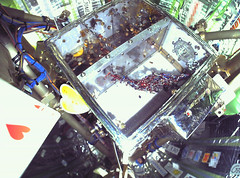
You can also look inside Genesis and see what’s already gone up (besides NASA’s GeneBox, that is). The picture above, by the way, is a box of Mexican jumping beans sent up in Genesis I by Bigelow Aerospace employees.

For $295 a pop, you can send up anything you want as long as it’s:

  • smaller than a golf ball;
  • less than 1 oz. in weight;
  • doesn’t contain any magnets;
  • doesn’t contain power-operated devices, liquid, or powder.

I’m not sure what options that leaves or whether the price beats a similar program from Masten Enterprises, but at least there’s now another way to send more junk into space.