Author Archive

DIY Friday: Androids

Friday, September 26th, 2008

That’s right DIY-ers, this week we’re taking on a big one. So, pop in your copy of Android on VHS (you know you still have it) and get ready for some nerdy weekend fun.

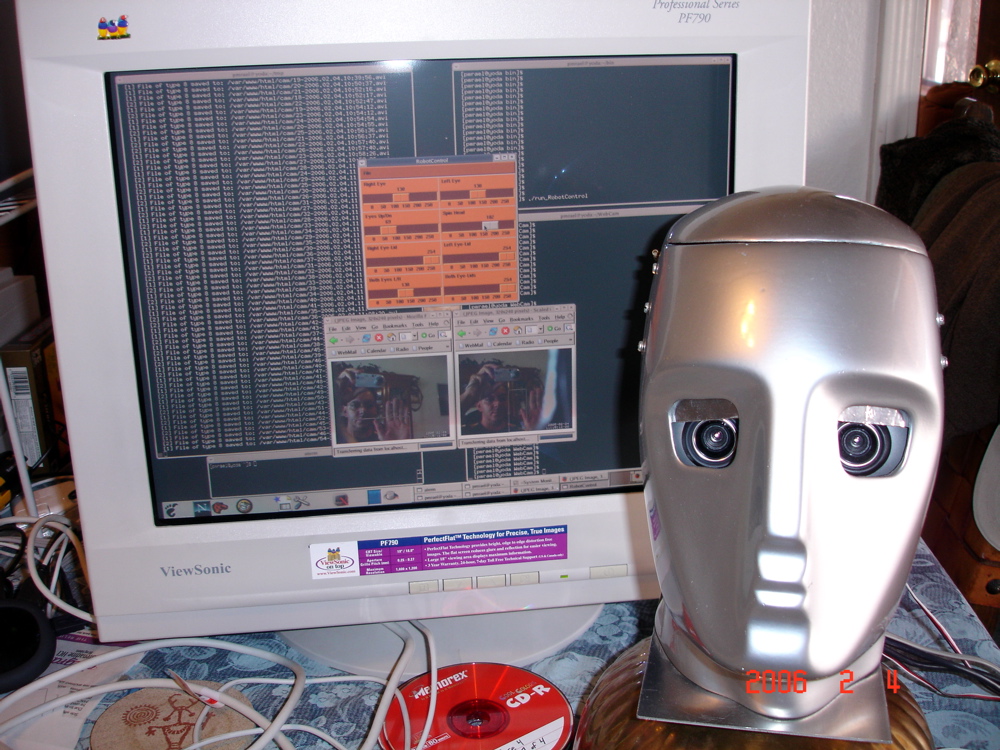
For the more ambitious among you, this site has detailed instructions for creating an android head. All the parts will set you back about $600.

If the state of our economy is making you a bit wary of dropping that much cash – come on, you know it’s worth eating ramen noodles for a month – you can always try building this one. It’ll just set you back $30.

Or, heck, cash in those shares and dream big:

While you’re at it, live out your favorite Android fight-scene moments with this kick-boxing android.

HDTV Race Update

Monday, September 22nd, 2008

In the HDTV race, it looks like satellite is still winning. At least according to this report from CNET. The report only tracks a few providers in each category, but the result is pretty clear.

In fact DirecTV claims even more HD channels than the CNET report counts. Their website lists over 130. DISH Network isn’t far behind, and they’re promising 150 HD channels by the end of this year.

About a year ago, Comcast promised 800 HD channels by the end of 2008. Though their definition of "channel" was a bit fishy:

[They] include everything from local stations to high-def networks such as Discovery HD Theater to HD Video on Demand services such as new video releases. In other words, if the movie Casino Royale is available in high-def on Comcast On Demand, that would be a channel choice. If Discovery HD Theater offers a handful of Planet Earth documentaries in high-def on demand, that, too, would be a channel choice.

They’re doing pretty well in reaching their target. Right now, they’re claiming "over 500 HD shows and movies at any given time".

If you’re a little (er…a lot) late jumping on the HD bandwagon, you can still buy a Pansat 9200HD for less than 400 bucks and downlink HD free-to-air via satellite. Check the Satellite Guys fora for more detail than you can handle.

DIY Friday: Satellite Tracker

Friday, September 19th, 2008

Check out this how-to for building your own "SAEBRTrack" box for tracking LEO satellites.

You can even find several examples from people who’ve built systems based on the SAEBRTrack design, like this one.

If that’s a bit too ambitious for your weekend plans, you can always use this site, which also has astronomical info including skycharts and daily sun and moon data.

This site is pretty awesome too. It tracks over a hundred satellites in real time. You can pick your favorites and track up to 5 on one map.


Russian HDTV

Monday, September 15th, 2008

Russians are getting an influx of HDTV offerings.

Platforma HD, the new Russian all-HDTV platform has selected the EUROBIRD(TM) 9 satellite operated by Eutelsat Communications (Euronext Paris: ETL) to deliver new HD content across western parts of Russia to the Urals. The new platform was launched in August in order to offer Platforma HD’s first subscribers the Beijing Olympics in HD with the Eurosport HD channel.

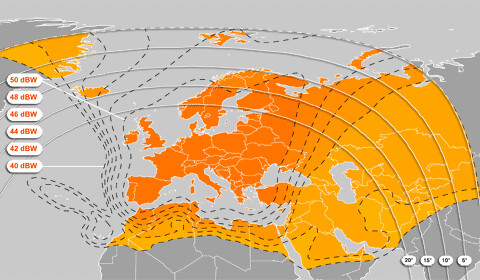
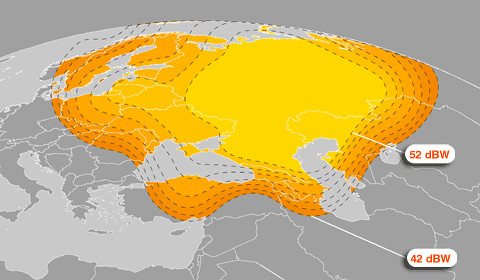
They’re using Eurobird 9, formerly Hotbird 2, in the 9 degrees East position, which doesn’t provide optimal coverage (as shown above). Hungarian HDTV, Hello HD, is also on the Eurobird 9, as we blogged a few months ago. But Platforma HD says they’ll be moving it to the 36 degrees East location in 2009. (Incase you read Russian, check it out here…)

This is bad news for people adding an LNB to their dishes in order to receive hundreds of Free-to-Air (FTA) channels from adjacent HOT BIRD at 13 degrees East.

We’re guessing this was all timed to coincide with the IBC show in Amsterdam, considered to be THE NAB show of Europe.

Speaking of Russian programming, Disney just announced that it is making its first Russian film. The movie will be based on some of Russia’s most famous fairy tales and is expected to be released next fall.

3 Billion New Internet Users on the Way?

Tuesday, September 9th, 2008

A start-up company, backed by some big names, is seeking to add 3 Billion new Internet users from poor, remote countries.

On Tuesday, O3b Networks Ltd., founded and run by 38-year-old telecommunications entrepreneur Greg Wyler, is expected to announce plans to launch as many as 16 satellites that could provide service to Africa, the Middle East and parts of Latin America by the end of 2010.

The undertaking, expected to cost about $650 million, has initial backing of about $60 million from investors that include HSBC Holdings PLC, Allen & Company, and Liberty Global Inc., in addition to Google.

Of course, the blogs are abuzz with the news that Google is launching 16 new satellites, especially after yesterday’s post about the GeoEye-1, but Google is only anteing up $20 million for the project.

The bigger news is about O3b, whose young CEO, Greg Wyler, has pulled together an impressive list of funders to tackle a very lofty goal.

This isn’t the first time that Wyler has launched an aggressive project to bring Internet access to the developing world. He also paired up with the Rwandan government in an effort to connect schools, government institutions and homes with low-cost, high-speed Internet service. The fate of that project contains some warnings for this venture. Rwandan officials say Wyler didn’t follow through on his promises:

Wyler says he sees things differently and that he and the Rwandan officials will probably never agree on why their joint venture has been so slow to get off the ground. But Terracom’s tale is more than a story about a business dispute in Rwanda. It is also emblematic of what can happen when good intentions run into the technical, political and business realities of Africa.

The technology behind the latest venture is a low-earth orbit system, built by Thales Alenia Space.

Side Note: O3b is headquartered in St. John, Jersey, Channel Islands. Never heard of it? Officially the "Bailiwick of Jersey”, it’s located in the English Channel, off the coast of France.

Google Maps is about to get even better

Monday, September 8th, 2008


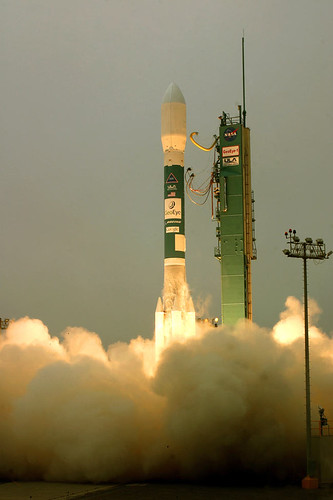
The GeoEye-1 satellite – the world’s highest resolution, commercial Earth-imaging satellite – was launched on Saturday.

You’ll soon be able to check out the satellite’s images for yourself:

ars technica In return for undisclosed terms, Google got two considerations: its logo on the side of the launch vehicle, and exclusive use of the mapping images that the satellite produces.

The satellite maker, General Dynamics Advanced Information Systems, says the GeoEye-1 cost $500 Million to build and launch and its imaging services could be sold for anything from environmental mapping to agriculture and defense. Funding for the project came from commercial satellite company GeoEye and the Defense Department’s National Geospacial-Intelligence Agency


DIY Friday: break the sound barrier?

Friday, September 5th, 2008

Yeah, pretty wild, right? Thanks to our friends at MAKE, it isn’t all that hard to create a sonic boom. The device is called a Bullwhip, but let’s just call it a “sound barrier breaking machine” – sounds more impressive.

Space Junk

Friday, September 5th, 2008

The more missions we undertake and the more satellites that launch into orbit, the more space "junk" that we’re inevitably left with. And we’re tracking much of it:

The U.S. Strategic Command maintains a catalogue currently containing about 13,000 objects, in part to prevent misinterpretation as hostile missiles. Observation data gathered by a number of ground based radar facilities and telescopes as well as by a space based telescope[6] is used to maintain this catalogue. Nevertheless, the majority of debris objects remain unobserved. There are more than 600,000 objects larger than 1 cm in orbit (according to the ESA Meteoroid and Space Debris Terrestrial Environment Reference, the MASTER-2005 model).

Now much of this debris can be tracked in realtime via Google Earth. Pretty cool.

"With the recent discussion of the ISS having to dodge some space junk, many people’s attention has once again focused on the amount of stuff in orbit around our planet. What many people don’t know is that USSTRATCOM tracks and publishes a list of over 13,000 objects that they currently monitor, including active/retired satellites and debris. This data is meaningless to most people, but thanks to Analytical Graphics, it has now been made accessible free of charge to anyone with a copy of Google Earth. By grabbing the KMZ, you can not only view all objects tracked in real-time, but you can also click on them to get more information on the specific satellite, including viewing it’s orbit trajectory. It’s an excellent educational tool for the space-curious. Disclaimer: I not only work for Analytical Graphics, but I’m the one that wrote this tool as a demo."

The U.S. Strategic Command tracks the junk mainly to prevent misinterpretation as hostile missiles; Google Earth does it mainly to offer another cool tool for nerds like myself to play with. But whatever our tracking purpose, one commenter on Slashdot may have the cure to all of our debris woes:

…we should put a black hole in orbit to take care of the debris. we can name it Hoover.

Sat-Phone Totin’ Cowboys

Tuesday, September 2nd, 2008

Home on the range is going high-tech.

The Bureau of Land Management is distributing satellite phones to cowboys working in areas prone to wildfires. The cowboys, who are often out of cell range, are the first line of defense for communities vulnerable to sudden fires.

The BLM says Owyhee County [Idaho]…is the first place the agency has armed cowboys with satellite phones…For an initial agency investment of $10,000, the seven Iridium satellite phones seemed a reasonable bargain, said Janet Peterson, the BLM’s safety manager in Boise — especially considering that 1,000-square-mile complex alone cost more than $13 million to fight and will likely set taxpayers back $34 million more to restore the blackened landscape.

Iridium has nearly 230,000 commercial and government voice subscribers, along with a unit that supplies equipment for companies and the U.S. Department of Defense to track assets in remote areas where there’s no conventional cellular communication. Voice users include soldiers, the maritime industry, oil and gas companies, utilities, construction and mining — "Basically any industry where you’ve got workers out in the middle of nowhere," Iridium spokeswoman Liz DeCastro said.

HD Wars

Monday, August 25th, 2008

There’s a race going on to win the largest number of HD channels. In Europe, Eutelsat just pulled ahead, boasting 49 high-def channels vs. SES Astra’s 42.

As in any long-distance race there will be moments when the lead changes, and there s every likelihood that by the end of the year Astra will be carrying nearer 60 HD channels, perhaps even more, helped by BSkyB boosting its total to nearer 30 high-def channels. Canal Plus over France, Digital+ over Spain and Premiere’s HD plans over Germany will all add to Astra’s overall portfolio.

Despite the ramp-up in HD offerings, Screen Digest says many homes that have HD sets don’t use them to view broadcast high-def.

The report confirms that Astra, as at Dec 31st last year, had more than 1.2m homes viewing high-def programming. But this is still a miserable number considering Europe s 29.8m homes with HD-Ready devices installed. North America, also at Dec 31st, had 32.3m HD-Ready sets in use, and an impressive 19.3m viewing HD.

The trend is expected to change by 2012, with Europe taking the lead in high-def homes.